New York City is changing the way poverty in the city is defined, while the Federal government is considering a bill to do the same. Planetizen Assistant Editor Nate Berg reports in The Christian Science Monitor.


"For the federal government, the concept of poverty is simple. If a typical family of four earns less than $21,100 a year, they're poor. If a single working woman makes less than $10,787, she's in poverty.
It doesn't matter whether these people live in Omaha, Neb., where the average apartment rents for $600 a month, or in New York City, where a similar apartment costs $1,600 a month. That's the way it's been since the federal government decided how to measure poverty in the mid-1960s.
Now, a steadily growing number of experts and policymakers argue that the poverty line should look like a wave, fluctuating with geography. That's the way New York officials see it, too. Last month, they unveiled a first-of-its-kind poverty measure that includes the city's actual costs of living.
'It really changes the picture of what the current face of poverty is,' says Linda Gibbs, New York's deputy mayor for health and human services."
Read the full story: Who's poor? It depends on where you live, some say.
Research: Sprawl Linked to Poverty
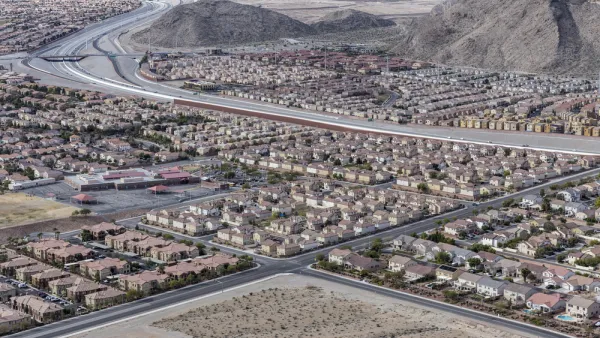
Low-income families living in high-sprawl neighborhoods are limited in their access to education, jobs, and other amenities, often trapping them in a cycle of poverty.
Is Inequality Destroying American Cities?
A recent video claimed that high income inequality is the “Thing That Will Destroy Our Cities.” Is this true?

Rural Areas Experience Higher Food Insecurity
As pandemic-era assistance programs expire, the rate of food insecurity for rural households is rising higher than in their urban counterparts.

Planetizen Federal Action Tracker
A weekly monitor of how Trump’s orders and actions are impacting planners and planning in America.

California plans to bury El Niño’s downpour
If the state plays its cards right, it may be able to store a billion acre-feet of El Niño’s water in aquifers.

Desperate measures: Advocates weigh draining Lake Powell to fill Colorado River
Draining the reservoir could reduce evaporation losses by a couple hundred thousand acre-feet.

In Texas, data centers are swallowing promised parkland
Residents who moved to Taylor, Texas for a rural community now have to contend with three data centers in their backyard.

How a Chicago-sized wind farm beat the odds and powered on
The project spanned five presidential administrations and a standoff with a U.S. military base.

MTA gives itself 30 days to transform pit into basketball court
The site has been under construction since 2022; the city originally estimated it would finish the court in 2024.

FREE Course: Walkable City 1: Why Walkability?
After describing his path towards focusing on walkability as the essence of good planning, Jeff Speck marches through his five principal reasons for making more walkable places.
Reinventing Malls: Planning Alchemy—Turning Gray Fields Into Gold
The course focuses on the opportunities and imperatives that shape reinvention of mall sites.

City of Rosemead
Rutgers University, Edward J. Bloustein School of Planning and Public Policy
One Hundred Miles
Hunter College, City University of New York (CUNY)
The Architects Foundation
University of Cincinnati Online
City of Cambridge
Montrose County
The Pocatello Development Authority