The Futurama exhibit at the 1939 World's Fair excited an entire generation about suburbia. At a meeting of the Citistates Group, policy wonks wondered whether it's possible to create a new vision of a Carbon-Free Futurama.


"If Californians – and Americans -- are going to cut greenhouse gas emissions, they're going to have to drive less. But is wonking on policy really the best way to make this happen? Or do we have to create a compelling alternate vision for the next generation's lifestyle – a kind of Carbon-Free Futurama?
There's a lot of discussion about how policy can affect VMT. But policy may be too slow and too reactive. At least that seemed to be the consensus at the informal, once-every-now-and-then, and extremely wonky gathering of Neal Peirce's Citistates Group.
So how else do we go after this? By presenting a positive alternative lifestyle that focuses on "high efficiency and low impact," at least according to all-purpose policy wonk Marc Weiss and economist Doug Henton.
Which leads to the obvious question: What would the Carbon-Free Futurama look like?"
Thanks to Bill Fulton
Read the full story: The Carbon-Free Futurama

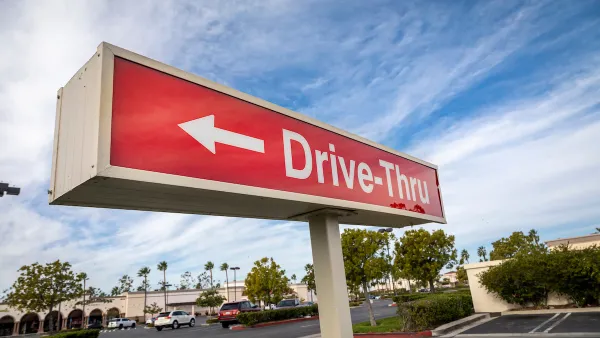
The Resurgence of Drive-Throughs
Dining areas in many fast food restaurants are being replaced with added drive-thru lanes, another post-pandemic impact on our lives benefiting those with four wheels (or more).
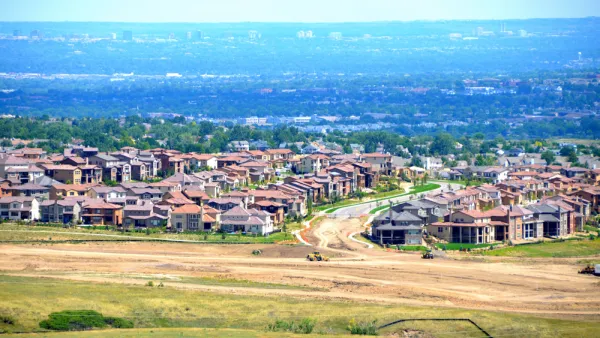
Majority of Americans Prefer Larger Homes and Longer Trips, Survey Says
The percentages have fluctuated on either side of the pandemic, but most Americans prefer to live in communities with larger houses, located farther away from schools, stores, and restaurants, according to a recent Pew Research Center survey.
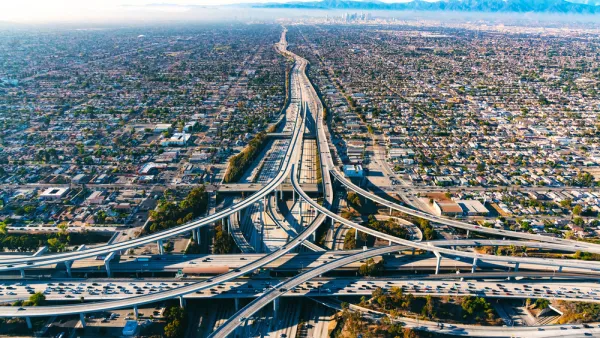
Essay: Will America Ever Change its Urban Patterns?
If there has ever been a good time to change our urban patterns, the time is now.

Planetizen Federal Action Tracker
A weekly monitor of how Trump’s orders and actions are impacting planners and planning in America.

The state-sanctioned urbicide of Austin
People don’t kill cities. Freeways do.

US to reduce Colorado River water deliveries to Mexico
A new Colorado Treaty amendment reduces Mexico’s Colorado River water allocation by 250,000 acre feet.

Brightline West’s future may rely on $6 billion federal loan
The company has until Nov. 2 to make a $400 million equity investment into its proposed high-speed rail line.

LA Metro’s ultimatum: no extra buses for LA28 if federal funding isn’t imminently secured
If Metro does not provide additional buses, LA28 organizers will have to find a new way to manage Olympic traffic. LA28’s budget does not include a line item for transit.

Colorado’s Largest Data Center Could Rise Next to Homes — Without a Public Hearing
The proposed campus would consume 11 times the power of Denver International Airport; as it has across the country, opposition mounts.

FREE Course: Walkable City 1: Why Walkability?
After describing his path towards focusing on walkability as the essence of good planning, Jeff Speck marches through his five principal reasons for making more walkable places.
Reinventing Malls: Planning Alchemy—Turning Gray Fields Into Gold
The course focuses on the opportunities and imperatives that shape reinvention of mall sites.

Eagle County Government
Harvard University Graduate School of Design
Nashville Planning Department
The Architects Foundation
University of Cincinnati Online
The Pocatello Development Authority
The Urban Renewal Agency of the City of Pocatello
Journal of the American Planning Association