Belgian architect Vincent Callebaut has designed a floating city with the noble goal of housing displaced peoples who's homelands have been destroyed.


The 'Lilypad City' would float around the world as an independent and fully self-sustainable home. With a lake at its centre to collect and purify rainwater, it would be accessed by three separate marinas and feature artificial mountains to offer the inhabitants a change of scenery from the seascape.
Power for the central accommodation hub is provided through a series of renewable energy sources including solar panels on the mountain sides, wind turbines and a power station to harness the energy of the waves.
Mr Callebaut said: 'The design of the city is inspired by the shape of the great Amazonia Victoria Regia lilypad. Some countries spend billions of pounds working on making their beaches and dams bigger and stronger.
'But the lilypad project is actually a long-term solution to the problem of the water rising.'
Read the full story: The floating cities that could one day house climate change refugees
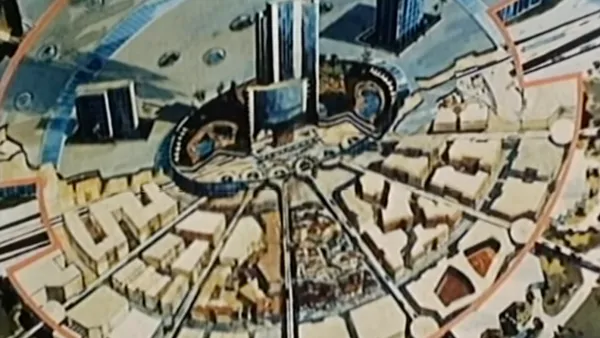
EPCOT: The Original 'Smart City'
What can today’s futurists learn from Disney’s unrealized utopia?
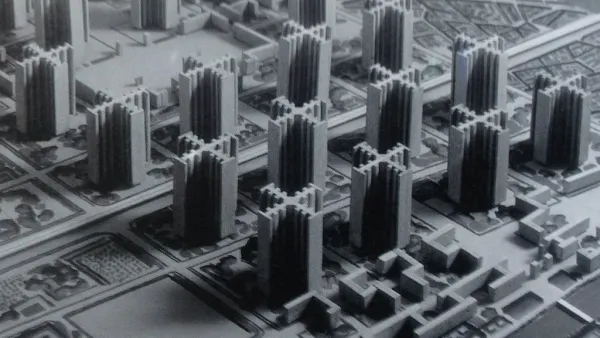
Op-Ed: Utopian Thinking Poses Continued Dangers for Urbanists
Charles Wolfe calls attention to similarities between contemporary urbanism and yesterday's debunked utopias. The two may differ in substance, but both tend toward a certain level of dogma that isn't necessarily helpful on the ground.

The 'Floating City' of the Silicon Valley's Dreams
The country of French Polynesia is on the verge of permitting a floating city, funded by wealthy Silicon Valley interests and sustained by utopian dreams.

Planetizen Federal Action Tracker
A weekly monitor of how Trump’s orders and actions are impacting planners and planning in America.

California plans to bury El Niño’s downpour
If the state plays its cards right, it may be able to store a billion acre-feet of El Niño’s water in aquifers.

Desperate measures: Advocates weigh draining Lake Powell to fill Colorado River
Draining the reservoir could reduce evaporation losses by a couple hundred thousand acre-feet.

Mamdani’s pied-à-terre tax survives legal challenge
A panel of judges found that the plaintiffs failed to demonstrate injury as a result of New York City's implementation of the tax.

Eastern Nebraska is running out of electricity
Data centers and electrification are straining eastern Nebraska’s grid, throttling economic development.

Seattle passes record-breaking transit services expansion
Proposition 1 will double the city’s transit tax to add 95,000 more bus trips and preserve 180,000 bus trips annually.

FREE Course: Walkable City 1: Why Walkability?
After describing his path towards focusing on walkability as the essence of good planning, Jeff Speck marches through his five principal reasons for making more walkable places.
Reinventing Malls: Planning Alchemy—Turning Gray Fields Into Gold
The course focuses on the opportunities and imperatives that shape reinvention of mall sites.

City of Rosemead
Rutgers University, Edward J. Bloustein School of Planning and Public Policy
One Hundred Miles
University of Michigan School for Environment and Sustainability (SEAS)
Hunter College, City University of New York (CUNY)
The Architects Foundation
City of Cambridge
Montrose County
The Pocatello Development Authority