This article from LA Weekly looks at L.A.'s parks deficit and what some are trying to do to address it.


"Not all spaces are created equal."
"That's especially true in Los Angeles, where, when it comes to public space, the Maguire Gardens are the exception rather than the rule. The most park-impoverished major city in America, Los Angeles devotes only 4 percent of its land to public greenery. By contrast, parkland comprises 17 percent of New York City and 9 percent of Boston (where 97 percent of the city's children have immediate access to a park - as opposed to one-third of kids in Los Angeles). Even in San Diego, often dismissed as L.A.'s cultureless, beer-buzzed little brother, parks make up 16 percent of the landscape."
"Of the parks L.A. does have, many are caught in varying states of detritus. The jewel of our system, Griffith Park, is less park than wilderness area, and subject to the wildfires that devastated it last year. Elysian Park is beautiful but isolated and underused. And not only have Echo Park's famous paddleboats been sporadically removed from service due to budgetary woes, but Echo Park Lake has become so foul that the park's stunning lotus flowers have all but disappeared."
FULL STORY: Parks and Wreck: L.A.'s Fight for Public Green Space

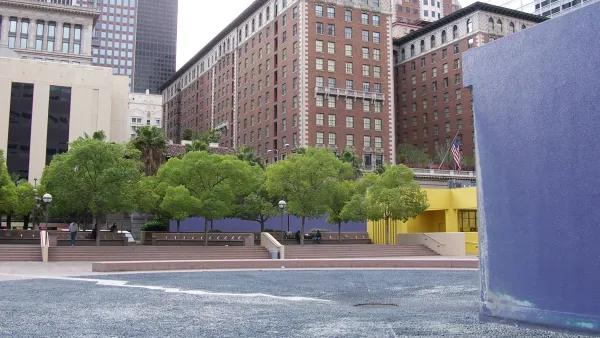
Los Angeles to Redesign Its 'Worst Public Space'
Josh Stephens reports on the Pershing Square Renew Design Challenge, an effort to redo one of the "world's worst squares and plazas." The new Pershing Square may hearken back to the years before its misguided 1992 redesign.
Cap and Play
This commentary from the Los Angeles Times calls for creation of a central park for the city, made by putting a "cap" over a section of freeway.
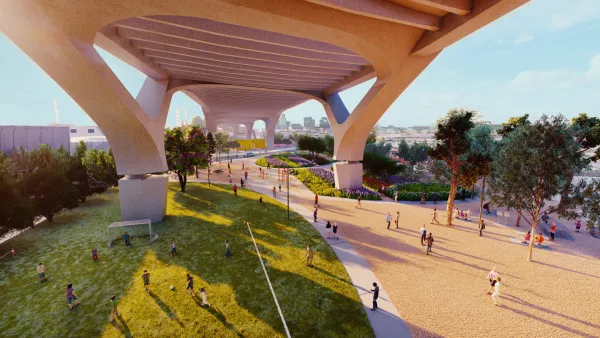
New Park Breaks Ground Under L.A.’s Sixth Street Viaduct
The park will connect to the Los Angeles River bike path and transit projects coming to the area.

Planetizen Federal Action Tracker
A weekly monitor of how Trump’s orders and actions are impacting planners and planning in America.

The state-sanctioned urbicide of Austin
People don’t kill cities. Freeways do.

US to reduce Colorado River water deliveries to Mexico
A new Colorado Treaty amendment reduces Mexico’s Colorado River water allocation by 250,000 acre feet.

5 New England states march closer to 800 megawatt wind energy project
Securing federal approval for the project may be complicated under the Trump administration, which has historically been hostile towards domestic wind power.

Baltimore to break ground on $50 million Transit Priority Project
The project will bring faster bus trips, safer streets and better bike connections to Baltimore.

Airbnb launches $250 million 'last-dollar financing' housing accelerator, makes first investment in Austin
The company will put $6.4 million towards affordable housing development in Texas’ capital.

FREE Course: Walkable City 1: Why Walkability?
After describing his path towards focusing on walkability as the essence of good planning, Jeff Speck marches through his five principal reasons for making more walkable places.
Reinventing Malls: Planning Alchemy—Turning Gray Fields Into Gold
The course focuses on the opportunities and imperatives that shape reinvention of mall sites.

Eagle County Government
Harvard University Graduate School of Design
Nashville Planning Department
The Architects Foundation
University of Cincinnati Online
The Pocatello Development Authority
The Urban Renewal Agency of the City of Pocatello
Journal of the American Planning Association