As part of a new strategy to prevent deforestation in the Amazon, government officials in Brazil have begun seizing livestock that graze on illegal ranches.


"In an unprecedented move against rogue cattle ranchers in the Amazon, the Brazilian government has seized livestock grazing there illegally, the new environment minister announced Tuesday."
"Officials carted off 3,100 head of cattle that they said were being raised on an ecological reserve in the state of Para, in an operation intended to serve as a warning to other ranchers grazing an estimated 60,000 head on illegally deforested land in Amazonia, the environment minister, Carlos Minc, said."
"Fears have been growing over the future of the world's biggest rain forest. Though annual deforestation figures fell to a 16-year low of 4,333 square miles in 2007 - from a nine-year high of 10,571 square miles in 2004 - government agencies reported this year that deforestation was on the rise again, and cattle farmers were blamed for much of the increase."
"Mr. Minc said the cattle would be auctioned in two weeks and the proceeds go to Fome Zero, as well as to health programs for indigenous peoples and to finance cattle removal operations, the government's food program for the poor."
Read the full story: Brazil Seizes Livestock to Protect Rain Forest
Brazil Looks to Land Titles to Protect Amazon
A new plan is taking form in Brazil to regularize titles to rainforest land -- an effort the government hopes will fight deforestation.

Land Use the Subject of Latest IPCC Report
Not urban land use, but in the literal sense: land used to produce food, graze livestock, supply drinking water, grow trees, and sequester carbon. As the climate warms and the population grows, crop yields will decrease and land will be degraded.
Hydroelectric Dam Energizes and Displaces in Amazon
Plans to construct an $11 billion hydroelectric dam in the Amazon rainforest of Brazil has officials excited about the new energy it will create, and some locals preparing to relocate.

Planetizen Federal Action Tracker
A weekly monitor of how Trump’s orders and actions are impacting planners and planning in America.

Washington state to charge fee to drivers with fuel-efficient cars
Revenue from the fee will go towards supporting the state’s highways.
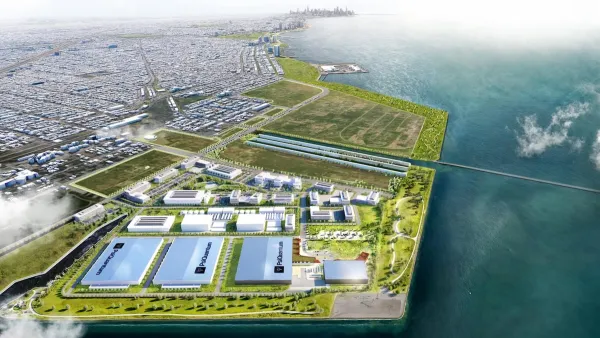
Illinois considers spending $1 billion in taxpayer money on data center
A quantum computing campus and data center are currently under construction in Chicago.

Did data centers change how voters cast their ballots?
Texas, Ohio, and Georgia all flipped party control. But in rural counties, the effect of local data centers was mixed.

Amtrak invests in eight new Airo trainsets
The new trainsets will begin serving passengers in 2031.

HUD to end aid for mixed-immigration-status households
The new rule is projected to impact 80,000 people, nearly half of whom are children.

FREE Course: Walkable City 1: Why Walkability?
After describing his path towards focusing on walkability as the essence of good planning, Jeff Speck marches through his five principal reasons for making more walkable places.
Reinventing Malls: Planning Alchemy—Turning Gray Fields Into Gold
The course focuses on the opportunities and imperatives that shape reinvention of mall sites.

City of Charlotte
City of Rosemead
Rutgers University, Edward J. Bloustein School of Planning and Public Policy
University of Michigan School for Environment and Sustainability (SEAS)
Hunter College, City University of New York (CUNY)
The Architects Foundation
University District Partnership