The city of Omaha, Nebraska, has announced plans to build a network of bike lanes throughout the city, boosted by private contributions of more than $600,000.


"As part of Bike to Work Month, Mayor Mike Fahey announced on Monday that the city landed enough money to start connecting the Keystone Trail to the Riverfront Trail, and Creighton University to the Henry Doorly Zoo. The city also wants to add bike lanes to some extra-wide streets, create new street markings, add signage and create a new committee of bikers and pedestrians."
"'In cooperation with the city, Activate Omaha and Bikeable Communities, we have been successful in securing $600,000 in private contributions for the creation of Omaha's first on-street bicycle route system,' Fahey said, before kicking off a ceremonial ride to work."
From the Omaha World-Herald:
"The street routes will connect the Riverfront Trail with the Keystone Trail in central Omaha. From north to south, the Creighton University campus will be connected to the Henry Doorly Zoo."
"The idea is to create street routes that allow cyclists to ride from the trails in central Omaha to downtown without having to use busy arterial roads such as Dodge Street."
"The exact streets and design of the lanes have not been determined. Marty Shukert, a former Omaha city planning director who is active with the local group Bikeable Communities, said the route probably will use secondary streets that once served as streetcar routes. Those streets are wider and offer a place to install a bicycle lane without having to widen streets."
"Signs also may be used to alert motorists to the presence of cyclists."
"Shukert said that streets are much harder for cyclists to navigate than the city's trail system."
Read the full story: Omaha To Add Bike Lanes, Connect Trails

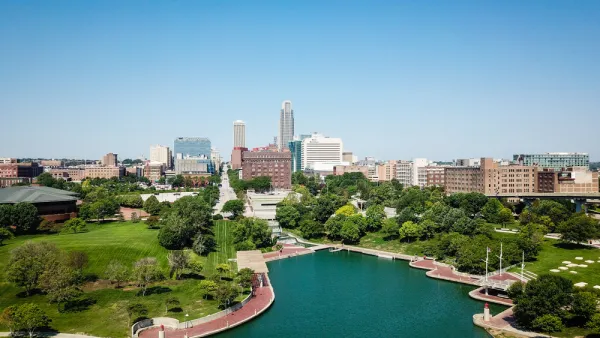
Omaha to Lose its Only Protected Bike Lane
With an 18-month pilot program coming to an end, local officials plan to dismantle the city’s only protected bike lane.
Flushing Drivers Out of the Bike Lane in Omaha
Activists use plungers to unclog streets for bikers, as tide of active transit flows unimpeded across America's planes.
Responding to Bike Improvement Skeptics
Communities can receive high economic returns from appropriate bicycle facility invesments. It is important that advocates have solid arguments for responding to skeptics.

Planetizen Federal Action Tracker
A weekly monitor of how Trump’s orders and actions are impacting planners and planning in America.

California plans to bury El Niño’s downpour
If the state plays its cards right, it may be able to store a billion acre-feet of El Niño’s water in aquifers.

Chicago breaks ground on $3 billion megadevelopment
The new neighborhood, titled Foundry Park, will one day host 3,700 residences.

LA may place emergency ban on karaoke room permits
If Councilwoman Heather Hutt’s proposal passes, the moratorium would last between 45 days and one year.

City officials are dumping billions of gallons of sewage into the Chicago River
This year, the Racine Avenue sewage pumping station has poured over 10 billion gallons of sewage into the Chicago River.

Move over, LA: St. Louis gears up for Olympics, invests millions in downtown redevelopment
The Missouri city will host the 2028 Olympic soccer group stage and knockout matches.

FREE Course: Walkable City 1: Why Walkability?
After describing his path towards focusing on walkability as the essence of good planning, Jeff Speck marches through his five principal reasons for making more walkable places.
Reinventing Malls: Planning Alchemy—Turning Gray Fields Into Gold
The course focuses on the opportunities and imperatives that shape reinvention of mall sites.

City of Rosemead
Rutgers University, Edward J. Bloustein School of Planning and Public Policy
One Hundred Miles
Hunter College, City University of New York (CUNY)
The Architects Foundation
University of Cincinnati Online
City of Cambridge
Montrose County
The Pocatello Development Authority