In Sao Paulo, Brazil, planners are challenged with untangling traffic jams that stretch for over 120 miles.


"In Brazil's financial capital of Sao Paulo, the traffic is so bad that vendors line its major highways during rush hour, selling cold beer and snacks to motorists.
Traffic jams around the city can total more than 200 km (124 miles), and on a good day it can take more than two and a half hours to cross town.
The gridlock underscores a broader challenge facing the Latin American giant. As the economy booms, the country's creaky infrastructure is bursting at the seams, forcing public officials to scramble for ways to compensate for decades of poor planning.
"For too long, the prevailing mind-set in this country has been to tackle problems with temporary solutions that bring a short-term fix," said Candido Malta Campos, an urban planner at the University of Sao Paulo.
"If we keep doing that, Sao Paulo is going to grind to a halt in four or five years." "
Read the full story: Sao Paulo slows to a crawl as economy booms
Street Interventions In Brazil
Activists in Brazil took advantage of their country's fascination with the World Cup to take to the empty streets and paint messages encouraging safer use of the roads.
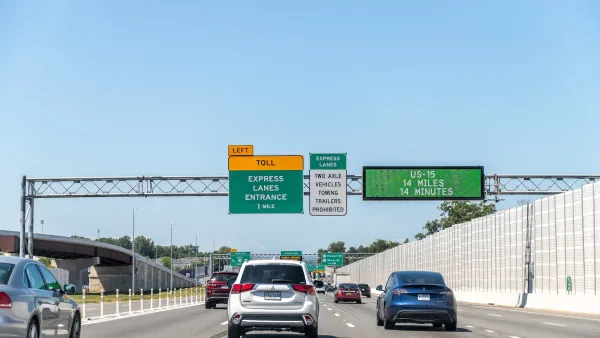
Congestion Costing Reality Check, Part 2: A congestion costing critique
There are good reasons to be skeptical of highway industry claims that traffic congestion is a growing problem. Their analysis is often incomplete and biased. Let’s pull back the curtain on some major congestion cost studies.
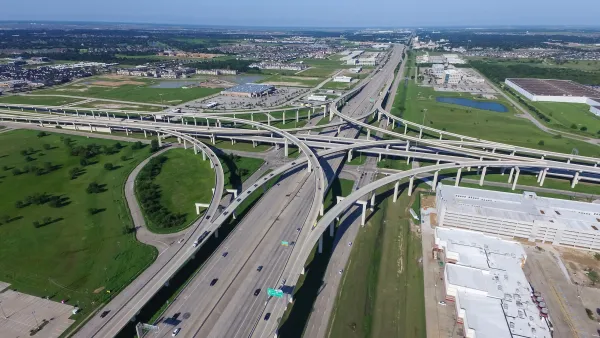
Induced demand is real: Commutes on Houston's 26-lane freeway take 51% longer after expansion
A massive freeway expansion only led to longer drive times, showing that building more lanes won't solve congestion.

Planetizen Federal Action Tracker
A weekly monitor of how Trump’s orders and actions are impacting planners and planning in America.

Eastern Nebraska is running out of electricity
Data centers and electrification are straining eastern Nebraska’s grid, throttling economic development.

Washington state to charge fee to drivers with fuel-efficient cars
Revenue from the fee will go towards supporting the state’s highways.

Instead of building new housing, LA developers are turning mansions into mega-mansions
In the richest areas, the number of houses valued at $30 million with demolition permits has skyrocketed since 2018.

Illinois considers spending $1 billion in taxpayer money on data center
A quantum computing campus and data center are currently under construction in Chicago.

As development costs rise, Boston moves to lessen affordable housing requirements
The Boston Zoning Commission and the City Council still need to approve Boston Mayor Michelle Wu’s proposed changes

FREE Course: Walkable City 1: Why Walkability?
After describing his path towards focusing on walkability as the essence of good planning, Jeff Speck marches through his five principal reasons for making more walkable places.
Reinventing Malls: Planning Alchemy—Turning Gray Fields Into Gold
The course focuses on the opportunities and imperatives that shape reinvention of mall sites.

City of Charlotte
City of Rosemead
Rutgers University, Edward J. Bloustein School of Planning and Public Policy
University of Michigan School for Environment and Sustainability (SEAS)
Hunter College, City University of New York (CUNY)
The Architects Foundation
University District Partnership
City of Cambridge
The Pocatello Development Authority