One Philadelphia councilman wants his city to follow the lead of more pedestrian-friendly New York and ensure that construction projects don't interfere with sidewalks.


"Pity Philadelphia's walking majority. Its precious sidewalks are increasingly being taken in brazen landgrabs by the city's powerful construction industry, which erects flimsy chain-link fences to mark turf, sometimes for the sole purpose of allowing contractors to park for free. The pedestrian's daily passage is further challenged by smelly dumpsters, concrete barriers erected in the name of homeland security, and awkwardly designed wheelchair ramps."
"James F. Kenney, an at-large city councilman, had always assumed this was the way it worked in all big cities. Then he took his family on a trip to New York and discovered that not once was his trajectory interrupted on Manhattan's crowded streets, even though it has at least five times as many high-rise construction projects as Philadelphia.
Instead of battered chain link, Kenney found an orderly arrangement of sidewalk sheds that guarantee New York's sidewalks are always open for business. The structures usually involve a sturdy wooden roof held up by an allée of metal poles. If it's impossible to build over the sidewalk, contractors must carve a safe passage in the street.
The sheds do more than keep the way clear for pedestrians. They enable merchants to continue serving their customers - and stay in business - during lengthy projects. They also provide safe storage and staging room for construction crews, and help shield everyone from falling debris. Contractors must illuminate the underside of the covered walkways with a string of bulbs so they're safe at night.
When Kenney saw those lights, he really saw the light.
Why, he wondered, doesn't Philadelphia require sidewalk sheds? Why doesn't it insist on safe-passage corridors? And why doesn't it charge developers for appropriating the sidewalk for their own use?
He got to ask those questions last week during a City Council hearing he requested on pedestrian obstructions. Kenney brought in a New York construction official to testify, along with witnesses from Philadelphia regulatory agencies, design groups, and the Pennsylvania Council of the Blind. They offered their thoughts while a video loop of some of the city's worst sidewalk hogs played in the background, courtesy of the Design Advocacy Group. Now, Council is trying to determine the best way to implement changes."
Thanks to ArchNewsNow
Read the full story: Changing Skyline: The city has lost control of its sidewalks

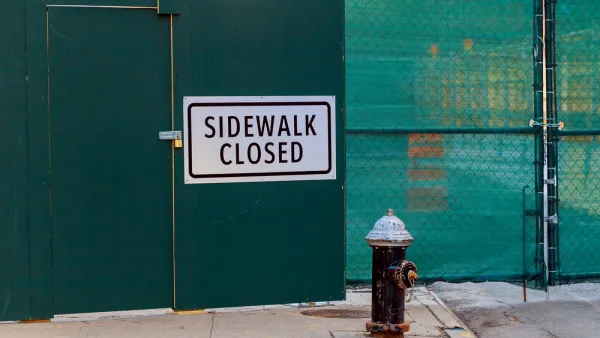
For Once, Cars, Not Pedestrians, Make Room for Construction
In a welcome turnabout of the usual state of affairs, a Philadelphia construction site gives a lane of traffic to pedestrians to make up for the three blocks of sidewalk it's taking.
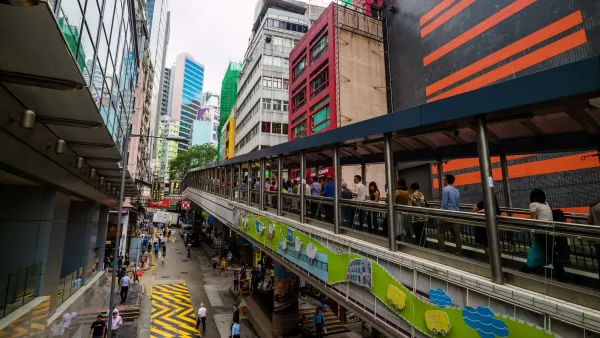
How cars killed the dream of the moving sidewalk
At the turn of the 20th century, moving sidewalks promised efficient, comfortable movement of pedestrians. Then cars took over.
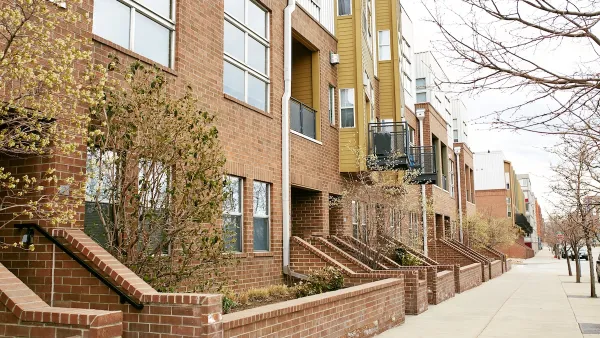
Denver to Shift Sidewalk Repair Work to City, Funded by Property Owners
The city is shifting from a piecemeal approach to sidewalk repairs that charged property owners with doing the work to a more streamlined, city-led process.

Planetizen Federal Action Tracker
A weekly monitor of how Trump’s orders and actions are impacting planners and planning in America.

Amtrak, CN end decades-long dispute with eight-year agreement
The new operating agreement establishes an updated framework for the companies to work together, including processes to resolve disputes.
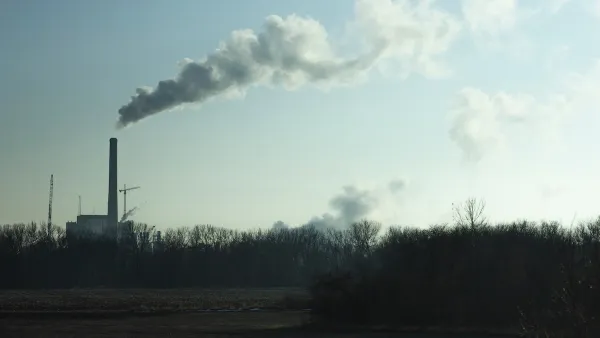
Nation's most wind-powered state turns to coal as data centers increase energy demand
For the first time in decades, Iowa has increased its generation of coal power.

Alabama scores up to $2.5 billion federal loan for largest infrastructure project in state’s history
The Mobile River Bridge and Bayway Project aims to ease congestion at Alabama’s worst bottleneck.

Trump is considering data centers on 6 states' public land — some state officials say they had no idea
If the administration approves the proposed projects, data center and data center-related developments will cover 17,600 acres of public land.

Despite court ruling, Trump is keeping nearly all wind projects in the US on hold
At least 110 wind energy projects have not heard from the government since a federal judge ruled that the Trump administration's freeze on wind turbine clearances was likely illegal.

FREE Course: Walkable City 1: Why Walkability?
After describing his path towards focusing on walkability as the essence of good planning, Jeff Speck marches through his five principal reasons for making more walkable places.
Reinventing Malls: Planning Alchemy—Turning Gray Fields Into Gold
The course focuses on the opportunities and imperatives that shape reinvention of mall sites.

KFH Group Inc.
Greater Baltimore Committee
Eagle County Government
The Architects Foundation
University of Cincinnati Online
The Pocatello Development Authority
The Urban Renewal Agency of the City of Pocatello