Though congestion pricing was shot down, New Yorkers are thinking about new ways to experience and use their streets.


"Ideas for calming New York's historically hectic streets go far beyond congestion pricing. Those ideas, moreover, seem to signal a shift in the basic thinking of what streets are for."
"'For decades, the Department of Transportation's job has been to move vehicles as quickly as possible,' said Janette Sadik-Khan, the agency's commissioner. 'We're taking a look at it a little bit differently now. There is a tremendous hunger for what we can do to make it easier for people to get around, to improve the quality of our streets and plazas, to make it easier for people to linger.'"
"These street reformers - planners, architects and urban officials from around the globe - are questioning the conventional street-curb-sidewalk motif, challenging the dominance of cars, and devising ways to use street furniture, plants and even radical new vehicles to transform the experience of the street."
"While they do not necessarily agree on the particulars, the advocates often share an excitement, a feeling of being present at the creation."
Read the full story: Taking Back the Streets
Boston to study congestion pricing in NYC
Mayor Michelle Wu said she was sending a delegation to NYC to understand congestion pricing's impact on the city.

Data reveals that NYC’s bet on congestion pricing has paid off
After almost two years of the program, reports show positive impacts on traffic and air quality and no disruptions to parking.
Congestion Costing Reality Check, Part 3: Smart congestion relief
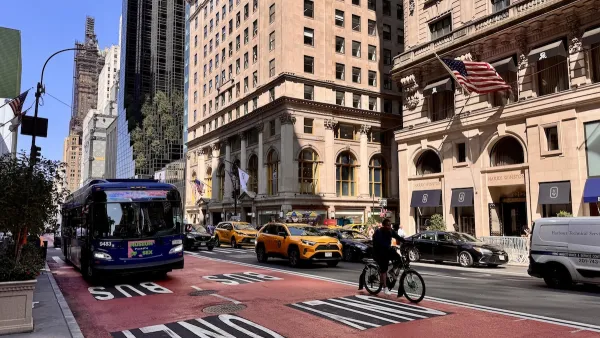
There are many better ways to reduce congestion in your city than expensive roadway expansion projects. Win-win strategies reduce congestion and provide many other benefits.

Planetizen Federal Action Tracker
A weekly monitor of how Trump’s orders and actions are impacting planners and planning in America.

California plans to bury El Niño’s downpour
If the state plays its cards right, it may be able to store a billion acre-feet of El Niño’s water in aquifers.

Desperate measures: Advocates weigh draining Lake Powell to fill Colorado River
Draining the reservoir could reduce evaporation losses by a couple hundred thousand acre-feet.

In Texas, data centers are swallowing promised parkland
Residents who moved to Taylor, Texas for a rural community now have to contend with three data centers in their backyard.

How a Chicago-sized wind farm beat the odds and powered on
The project spanned five presidential administrations and a standoff with a U.S. military base.

MTA gives itself 30 days to transform pit into basketball court
The site has been under construction since 2022; the city originally estimated it would finish the court in 2024.

FREE Course: Walkable City 1: Why Walkability?
After describing his path towards focusing on walkability as the essence of good planning, Jeff Speck marches through his five principal reasons for making more walkable places.
Reinventing Malls: Planning Alchemy—Turning Gray Fields Into Gold
The course focuses on the opportunities and imperatives that shape reinvention of mall sites.

City of Rosemead
Rutgers University, Edward J. Bloustein School of Planning and Public Policy
One Hundred Miles
Hunter College, City University of New York (CUNY)
The Architects Foundation
University of Cincinnati Online
City of Cambridge
Montrose County
The Pocatello Development Authority