Atlanta's Livable Communities Coalition has begun scoring development projects on 50 smart growth criteria and has recommended approval of its first project, a mixed-use development in Cobb County.


The coalition created a quality-growth test that poses 50 questions covering a variety of issues, including housing diversity, compactness, community needs and connectivity.
The Coalition's Smart Growth Scorecard uses teams of volunteer experts to rate proposed developments from poor to excellent on as many as 50 separate criteria in Livable Communities Coalition eight categories: location and availability of basic services; density and compactness; diverse mix of land uses; housing choice; accessibility, mobility, and connectivity; pedestrian safety, streetscapes, and parking; environmental protection; and community needs.
Points are assigned for each criterion, and the score for all criteria are then averaged. Projects must earn an average score of 3.0 points, or very good, to win recommendation for approval. Work on the Livable Communities Coalition Smart Growth Scorecard began last fall. The resulting scorecard was patterned after one developed by the Smart Growth Leadership Institute, an affiliate of Smart Growth America, which promotes smart growth nationwide.
Thanks to Otis White
Read the full story: Fifty questions to rate projects on quality growth

A Smart Growth Report Card
The Modesto Bee does a thorough ranking of cities and town in California's Central Valley and how 'smart' their growth is. Oakdale, CA comes out on top, while Gustine is the dunce of the group.

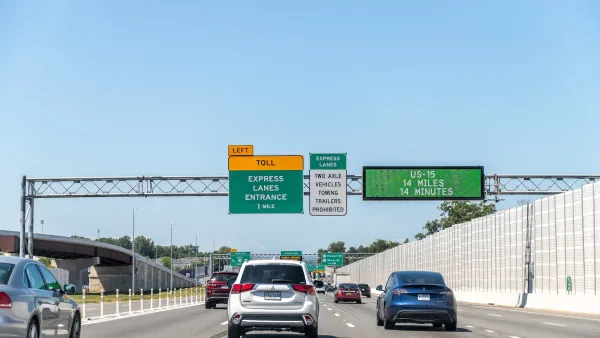
Congestion Costing Reality Check, Part 3: Smart congestion relief
There are many better ways to reduce congestion in your city than expensive roadway expansion projects. Win-win strategies reduce congestion and provide many other benefits.
Congestion Costing Reality Check, Part 2: A congestion costing critique
There are good reasons to be skeptical of highway industry claims that traffic congestion is a growing problem. Their analysis is often incomplete and biased. Let’s pull back the curtain on some major congestion cost studies.

Planetizen Federal Action Tracker
A weekly monitor of how Trump’s orders and actions are impacting planners and planning in America.

California plans to bury El Niño’s downpour
If the state plays its cards right, it may be able to store a billion acre-feet of El Niño’s water in aquifers.

Chicago breaks ground on $3 billion megadevelopment
The new neighborhood, titled Foundry Park, will one day host 3,700 residences.

Desperate measures: Advocates weigh draining Lake Powell to fill Colorado River
Draining the reservoir could reduce evaporation losses by a couple hundred thousand acre-feet.

This road in NYC is infamously dangerous — and Mamdani can't fix it
New York City's Ocean Parkway is known for reckless driving, but the power to implement safety measures lies with the state rather than the city.

One of Denver’s busiest corridors to gain BRT
The project will span 18 miles and contain 74 bus rapid transit stations.

FREE Course: Walkable City 1: Why Walkability?
After describing his path towards focusing on walkability as the essence of good planning, Jeff Speck marches through his five principal reasons for making more walkable places.
Reinventing Malls: Planning Alchemy—Turning Gray Fields Into Gold
The course focuses on the opportunities and imperatives that shape reinvention of mall sites.

City of Rosemead
Rutgers University, Edward J. Bloustein School of Planning and Public Policy
One Hundred Miles
Hunter College, City University of New York (CUNY)
The Architects Foundation
University of Cincinnati Online
City of Cambridge
Montrose County
The Pocatello Development Authority