A proposal to make Eugene, Oregon's bus system fare-free has been voted down by the regional transit district.


"LTD officials recently completed their analysis and came up with this conclusion: It doesn't pencil out."
"Free bus service has worked in some smaller communities where there's still plenty of capacity for new riders. "But we're in a different situation where we can't afford to absorb any more ridership," said Andy Vobora, LTD's director of service planning."
"Only 20 percent to 30 percent of LTD customers pay cash fares, with many more riding 'free' because of group pass plans paid for by their employers or schools. Fares of all types generate about $5.5 million annually for LTD, or roughly 15 percent of all revenues; a payroll tax on local businesses is the district's primary revenue source."
"Though some money would be saved by not collecting fares, LTD would still be looking at a total revenue gap of up to $5 million if it eliminated all fares - and would need some new state or local subsidy to make up the difference, Vobora said. Otherwise, LTD would have to look at budget and service cuts, he said."
Read the full story: LTD decides against free bus service
Magnetic Bus Idea To Test In Oregon
Transit officials in Eugene, Oregon, have announced plans to install a test route for a magnet-guided bus technology.
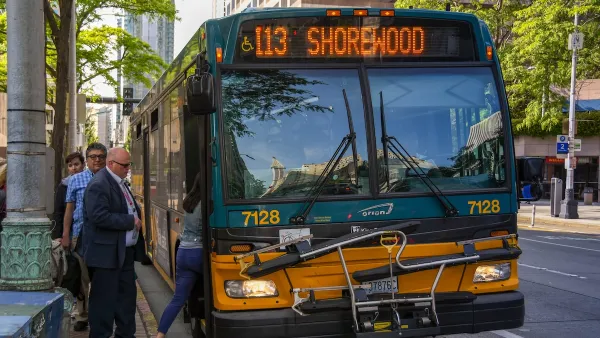
275,000 bus trips are at stake on Seattle's ballot
If passed, the Seattle Transit Measure would trigger a 0.3% sales tax and raise an average of $138 million per year to maintain and expand Seattle’s bus services.
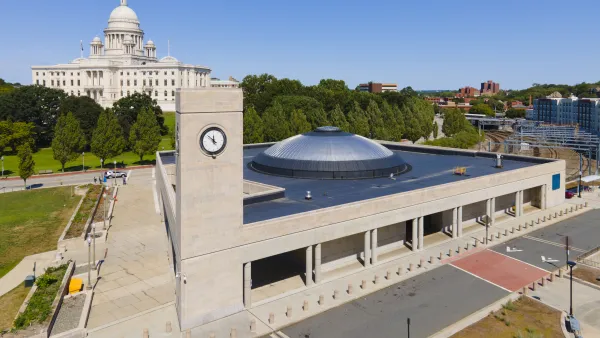
Providence train station to gain new bus hub
The new hub will replace the one currently located at Kennedy Plaza.

Desperate measures: Advocates weigh draining Lake Powell to fill Colorado River
Draining the reservoir could reduce evaporation losses by a couple hundred thousand acre-feet.

Eastern Nebraska is running out of electricity
Data centers and electrification are straining eastern Nebraska’s grid, throttling economic development.

Move over, LA: St. Louis gears up for Olympics, invests millions in downtown redevelopment
The Missouri city will host the 2028 Olympic soccer group stage and knockout matches.

Maryland’s $15 billion bridge project gains key approval
The Maryland Transit Authority said the project will create over 60,000 jobs and add $23 billion to the local economy.

‘No clear next steps’ for Chicago's permanent festival grounds
Eleventh Ward Ald. Nicole Lee has suggested Soldier Field as a possible location for the permanent event space.

California, Hawaii, Rhode Island approve housing propositions
Hawaii and Rhode Island each approved their sole proposition, while California approved two of its three.

FREE Course: Walkable City 1: Why Walkability?
After describing his path towards focusing on walkability as the essence of good planning, Jeff Speck marches through his five principal reasons for making more walkable places.
Reinventing Malls: Planning Alchemy—Turning Gray Fields Into Gold
The course focuses on the opportunities and imperatives that shape reinvention of mall sites.

City of Rosemead
Rutgers University, Edward J. Bloustein School of Planning and Public Policy
One Hundred Miles
University of Michigan School for Environment and Sustainability (SEAS)
Hunter College, City University of New York (CUNY)
The Architects Foundation
City of Cambridge
Montrose County
The Pocatello Development Authority