At the opening dinner of an international workshop on building a better national transportation policy, I found myself seated between Charlotte, North Carolina mayor Pat McCrory and Shirley DeLibero, a consultant who headed transit authorities in New Jersey and Houston, and was a deputy in both Dallas and Washington D.C. McCrory's a Republican, Charlotte's first six-term mayor, first elected mayor in 1995. While his city has grown 20 percent, McCrory's presided over a shift from an all-roads strategy to a hybrid model adding rail transit to heavily congested corridors radiated from the region's center. The first line, a south corridor, is scheduled to open this fall, supported by the half-cent sales tax passed in 1998 to build and operate a better transit system. Now in 2007, the mayor finds himself in a serious cross-fire as he ponders re-election prospects.


At the opening dinner of an international workshop on building a better national transportation policy, I found myself seated between Charlotte, North Carolina mayor Pat McCrory and Shirley DeLibero, a consultant who headed transit authorities in New Jersey and Houston, and was a deputy in both Dallas and Washington D.C.
McCrory's a Republican, Charlotte's first six-term mayor, first elected mayor in 1995. While his city has grown 20 percent, McCrory's presided over a shift from an all-roads strategy to a hybrid model adding rail transit to heavily congested corridors radiated from the region's center. The first line, a south corridor, is scheduled to open this fall, supported by the half-cent sales tax passed in 1998 to build and operate a better transit system. Now in 2007, the mayor finds himself in a serious cross-fire as he ponders re-election prospects.
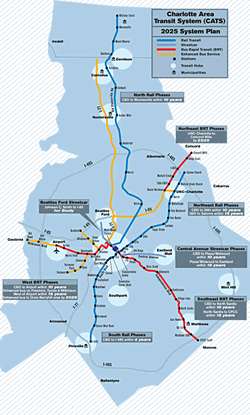 "I get it from both right and left," he told me. "The right just plain doesn't like transit and the left, well, they tell me it's not fair that we use ridership studies to determine where we can justify rail." They want rail service to come to their neighborhoods -- and now -- not 20 years from now. Enough people are lathered up over transit that there's a proposition on this fall's election ballot to repeal the transit tax. McCrory says it's just amazing "what three people and $60,000 can do to get the required signatures . . . all done by people I never heard of."
It wouldn't matter which party McCrory hailed from. He is a member of that club of mayors who have seen how important it is to shape the urban growth in their cities around better transportation choices. He sees the changes in residential development, the higher quality densities emerging, so far just from the anticipation of rail. This is the mayor who back in the 1990s bet his political capital on prohibiting any further residential development without sidewalks. He prevailed and survived then. But this fall could be another matter. He has active opposition emerging from candidates more conservative as well as more liberal.. "They all say I'm spending too much money on something only two percent of the people will use."
"That two percent number, it's hard to refute, "Shirley DeLibero chimed in. But you have to understand, she said, "the rules of the game are different for rail." She pointed out how cost comparisons quickly get distorted in public debate. "The department that builds roads rarely has to account for what they'll spend for the real estate," she said. But transit authorities do -- plus the cost of the rail cars and the structures to deliver the power. Are the comparisons ever done more fairly? Yes, she says, as she fondly remembers former New Jersey governor Christie Whitman who actually made the road lobby prove that a new road would be a better investment than transit in the same corridor.
Then there are other unofficial rules, such as never, never let the budget for a project increase over its original estimate, or you'll see headlines about "Costs soar .budget busted" She said "We brought that first Houston line in right on budget and on time, opening in January 2004. "If we hadn't finished on time, God forbid " Meanwhile, as she explained the different rules for road building, "The Katy Highway budget changed several times and almost nothing in the media about it."
McCrory's got both cost overruns and delays to shoulder in completing the first light rail line. "Nobody seems to connect the global demand for steel and concrete with our local project," he laments. He's also got an election coming up which, along with deciding his political future, will confirm Charlotte's complex transportation plan or repeal the past ten years of vision and investment


Planetizen Federal Action Tracker
A weekly monitor of how Trump’s orders and actions are impacting planners and planning in America.

Colorado’s Largest Data Center Could Rise Next to Homes — Without a Public Hearing
The proposed campus would consume 11 times the power of Denver International Airport; as it has across the country, opposition mounts.

US to reduce Colorado River water deliveries to Mexico
A new Colorado Treaty amendment reduces Mexico’s Colorado River water allocation by 250,000 acre feet.

'This is going to be painful:’ Virginia stares down $1.7 billion funding gap for highway maintenance
The state may address the deficit by shifting $290 million from its construction budget to maintenance projects.

Judges permit Denver to divert 77,000 acre feet from the Colorado River for reservoir expansion
Overuse and climate change have caused the Colorado River’s water levels to plummet.
Amtrak, CN end decades-long dispute with eight-year agreement
The new operating agreement establishes an updated framework for the companies to work together, including processes to resolve disputes.

FREE Course: Walkable City 1: Why Walkability?
After describing his path towards focusing on walkability as the essence of good planning, Jeff Speck marches through his five principal reasons for making more walkable places.
Reinventing Malls: Planning Alchemy—Turning Gray Fields Into Gold
The course focuses on the opportunities and imperatives that shape reinvention of mall sites.

KFH Group Inc.
Greater Baltimore Committee
Eagle County Government
The Architects Foundation
University of Cincinnati Online
The Pocatello Development Authority
The Urban Renewal Agency of the City of Pocatello

