Author James Howard Kunstler discusses Ontario' new green-belt protection plan to halt sdevelopment outside the Greater Toronto area.


An excerpt from Kunstler's response in the interview: "I believe most of suburbia is unreformable and will not be fixed. It represents, after all, the greatest misallocation of resources in the history of the world. We built it during our most affluent period of history, and in the decades to come we will be comparatively destitute collectively. In short, we will not have the resources to retrofit most of suburbia.
What's more, we are in for a fiesta of default, repossession, and distress selling of suburban property, much of which will lose its presumed usefulness and monetary value in an energy-scarce economy.
As if that wasn't enough, consider how badly-built suburbia is. Many business buildings are not designed to outlast their tax depreciation periods, and the McHouses are made of particle board, vinyl siding, and stapled-on trim. A lot of suburbia will simply become the slums of the future. Most of the rest will be salvage or ruins."
Thanks to Profession of New Urbanism Listserv
Read the full story: Interview With James Howard Kunstler


Planetizen Federal Action Tracker
A weekly monitor of how Trump’s orders and actions are impacting planners and planning in America.
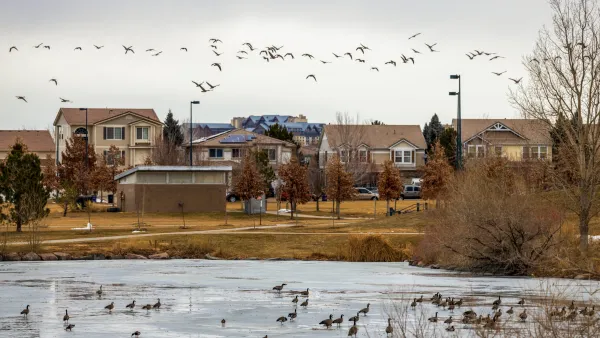
Colorado’s Largest Data Center Could Rise Next to Homes — Without a Public Hearing
The proposed campus would consume 11 times the power of Denver International Airport; as it has across the country, opposition mounts.

US to reduce Colorado River water deliveries to Mexico
A new Colorado Treaty amendment reduces Mexico’s Colorado River water allocation by 250,000 acre feet.

Judges permit Denver to divert 77,000 acre feet from the Colorado River for reservoir expansion
Overuse and climate change have caused the Colorado River’s water levels to plummet.

Amtrak, CN end decades-long dispute with eight-year agreement
The new operating agreement establishes an updated framework for the companies to work together, including processes to resolve disputes.

Raised interest rates may kill financially vulnerable construction projects
The chief economist at ConstructConnect warns that if construction project owners are negatively impacted by the raised rates, it could result in delayed payments to contractors.

FREE Course: Walkable City 1: Why Walkability?
After describing his path towards focusing on walkability as the essence of good planning, Jeff Speck marches through his five principal reasons for making more walkable places.
Reinventing Malls: Planning Alchemy—Turning Gray Fields Into Gold
The course focuses on the opportunities and imperatives that shape reinvention of mall sites.

KFH Group Inc.
Greater Baltimore Committee
Eagle County Government
The Architects Foundation
University of Cincinnati Online
The Pocatello Development Authority
The Urban Renewal Agency of the City of Pocatello