The city has installed the pavilions along 15 blocks in Houston.


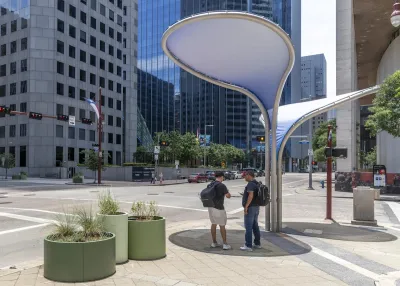
The streets of Houston just got a little cooler: Landscape architecture studio SWA has designed petal-shaped pavilions that bring shade to Houston's streets and make them more comfortable for pedestrians. The infrastructure is part of the city’s Public Realm Action Plan, which looks to make Houston’s streets more delightful and comfortable.
“The petal-shaped pavilions are made of bead-blasted stainless steel, with mesh membranes in gradients of blue, green and purple. They stretch up overhead, providing shade on street corners during the day, and integrated lighting illuminates them at night. According to the team, they were designed to be installed as a single unit, or clustered together to form ‘bouquets,’” Ellen Eberhardt writes for De Zeen.
SWA designed the infrastructure to work in various pre-existing sidewalk conditions. The city has installed the pavilions along 15 blocks in Houston.
Read the full story: SWA implements modular “toolkit” for a more walkable Houston

Refugees Learn to Survive as Pedestrians on Houston's Dangerous Streets
For one refugee family, living in Houston has meant facing a host of new challenges as they traverse the city’s roadways without a car.
Op-Ed: Houston Should Try to Kill Fewer Pedestrians
City officials in Houston have shown little regard for the safety of its people when they're walking outside, argues an op-ed in the Houston Chronicle.

Air taxis to connect Texas airports to business hubs
Archer Aviation says its taxis will turn 90 minute drives into 20 minute flights.

California plans to bury El Niño’s downpour
If the state plays its cards right, it may be able to store a billion acre-feet of El Niño’s water in aquifers.

Desperate measures: Advocates weigh draining Lake Powell to fill Colorado River
Draining the reservoir could reduce evaporation losses by a couple hundred thousand acre-feet.

Eastern Nebraska is running out of electricity
Data centers and electrification are straining eastern Nebraska’s grid, throttling economic development.

Houston gains petal-shaped cooling infrastructure to make streets more ‘delightful’
The city has installed the pavilions along 15 blocks in Houston.

After years of opposition to light rail, this L.A. city wants a $200 million station
Cerritos officials want the Southeast Gateway Line, a planned 14.5-mile light rail route through Los Angeles County, to stop in their city.

SpaceXAI may be fined $6 million for data center lacking water permits
A Mississippi agency also responds after a federal judge criticized the state’s Clean Air Act enforcement.

FREE Course: Walkable City 1: Why Walkability?
After describing his path towards focusing on walkability as the essence of good planning, Jeff Speck marches through his five principal reasons for making more walkable places.
Reinventing Malls: Planning Alchemy—Turning Gray Fields Into Gold
The course focuses on the opportunities and imperatives that shape reinvention of mall sites.

City of Rosemead
Rutgers University, Edward J. Bloustein School of Planning and Public Policy
One Hundred Miles
University of Michigan School for Environment and Sustainability (SEAS)
Hunter College, City University of New York (CUNY)
The Architects Foundation
City of Cambridge
Montrose County
The Pocatello Development Authority