The SHADE act also halves the allotted time for certain appeals before projects can progress.



San Francisco residents can no longer use shadows from potential buildings as a justification to delay or block new construction. While developers will still have to present a shadow analysis for any buildings that may cast shadows on city parks, the SHADE Act removes several processes that have delayed developments, including shadow review, and “cuts in half the allotted time for certain appeals before projects move forward,” Nicholas David writes for Mission City.
“[Supervisor Bilal Mahmood, who introduced the act] said that appeals involving shade had slowed down over 2,000 housing units in a dozen city projects since 2017, and said they are part of the city’s 'notorious' review process,” Mission City reports. Shadow concerns delayed a proposed 495-unit complex in the South of Market neighborhood for years.
The initial shadow review process was part of the city’s implementation of the California Environmental Quality Act. The law requires an environmental impact review for developments, but does not require a shadow analysis.
Read the full story: Out of the shadows: S.F. limits when shade can be used to block new housing

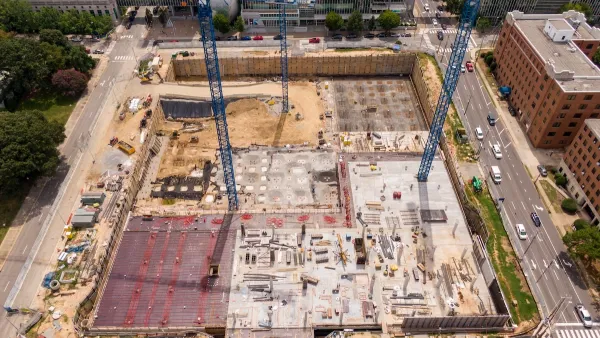
Novel study finds extreme state-by-state disparity in housing construction timelines
The first comprehensive working paper on U.S. construction timelines also found that the permitting process for multi-family projects has slowed nationwide.

Caltrain may slash over one-third of its stations
If Bay Area voters reject two transit tax measures, Caltrain, BART and AC Transit will see steep service cuts.

Newsom kills bill requiring polluting factories near schools to undergo environmental review
In his veto letter, Newsom wrote that protecting communities and strengthening manufacturing “were not mutually exclusive.”

Planetizen Federal Action Tracker
A weekly monitor of how Trump’s orders and actions are impacting planners and planning in America.

‘Going backwards:’ Baltimore mayor, students rally against state's transit funding plan
Maryland's proposed six-year plan provides no funding for Baltimore’s BMORE bus program and reduces its road maintenance funding.

Detroit to transform waterfront with $2.2 billion investment
Developers will convert about 18 acres of unused parking lot space into civic spaces.

Central Park has seen three deadly crashes since June. It banned cars 8 years ago.
100,000 bikers, pedestrians and horseback riders compete for space on the loop daily, sometimes resulting in deadly collisions.

SF residents can no longer use potential shadows to block housing developments
The SHADE act also halves the allotted time for certain appeals before projects can progress.

HUD, USDA agree on framework to simplify housing environmental review standards
Their agreement is a requirement of the 21st Century ROAD to Housing Act.

FREE Course: Walkable City 1: Why Walkability?
After describing his path towards focusing on walkability as the essence of good planning, Jeff Speck marches through his five principal reasons for making more walkable places.
Reinventing Malls: Planning Alchemy—Turning Gray Fields Into Gold
The course focuses on the opportunities and imperatives that shape reinvention of mall sites.

planning NEXT
City of Thousand Oaks
City of Wisconsin Rapids
The Architects Foundation
University of Cincinnati Online
Northern Illinois Transit Authority (NITA)
The Pocatello Development Authority
The Urban Renewal Agency of the City of Pocatello