The printer is able to build concrete walls much faster than humans, and can do so directly at job sites.


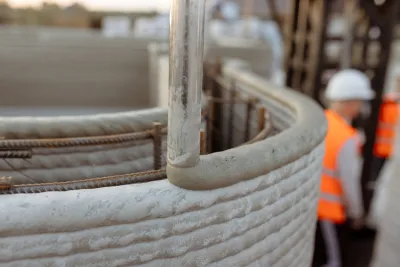
In a warehouse in Virginia, a robotic arm with a specialized nozzle is printing concrete walls in just 45 minutes, A.J. Nwoko writes for CBS 6. While people mix the ingredients for the concrete, the printer can construct concrete walls much faster than humans can, and workers can bring the machine directly to job sites.
CBS 6 reports:
"We need more housing to be built to meet present demand and to keep up with [the] future," [Virginia Housing Director of Strategic Housing Chris Thompson] said. "The technology is here; we can do this and now this is our first example of building this at scale and that's where we really need to be."
Virginia Tech University owns the mobile concrete printer, which was purchased using a $1.1 million grant from Virginia Housing.
Read the full story: Can this 3D concrete printer help Virginia's housing crisis?
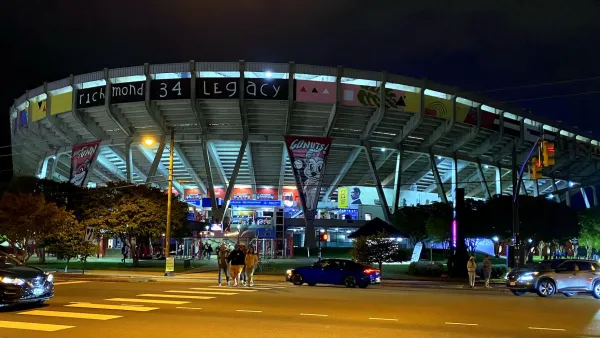
Richmond's new 'stadium district' will include hundreds of homes, offices, jobs
The city is planning for a neighborhood revival in the area around a new baseball stadium.

Phantom Tollbooths: Caltrans to Remove Bay Area Bridge Toll Booths Defunct Since 2020
The Richmond-San Rafael Bridge will be the first in the Bay Area to eliminate toll booths entirely in favor of open-road tolling using sensors.
Data Centers are Crushing Communities. One Virginia County is Changing That.
Henrico County’s innovative approach uses tax revenue from data centers to fund affordable housing.

Planetizen Federal Action Tracker
A weekly monitor of how Trump’s orders and actions are impacting planners and planning in America.

Washington state to charge fee to drivers with fuel-efficient cars
Revenue from the fee will go towards supporting the state’s highways.

Illinois considers spending $1 billion in taxpayer money on data center
A quantum computing campus and data center are currently under construction in Chicago.

Trump’s emergency orders to resuscitate coal plants cost ratepayers $593 million
Keeping coal plants on life support in Florida has cost ratepayers there $25.6 million.

Corpus Christi drilled wells at 'lightning speed,' leaving neighbors fearing for their water supply
Underground water became a critical fix through the worst of Corpus Christi’s drought. But experts warn against depending on wells for too long.

Nearly billion-dollar budget deficit looms over MTA
Metropolitan Transit Authority officials say the cost of healthcare, wages, electricity and fuel is outpacing revenue from tolls, taxes and fares.

FREE Course: Walkable City 1: Why Walkability?
After describing his path towards focusing on walkability as the essence of good planning, Jeff Speck marches through his five principal reasons for making more walkable places.
Reinventing Malls: Planning Alchemy—Turning Gray Fields Into Gold
The course focuses on the opportunities and imperatives that shape reinvention of mall sites.

City of Charlotte
City of Rosemead
Rutgers University, Edward J. Bloustein School of Planning and Public Policy
University of Michigan School for Environment and Sustainability (SEAS)
Hunter College, City University of New York (CUNY)
The Architects Foundation
University District Partnership