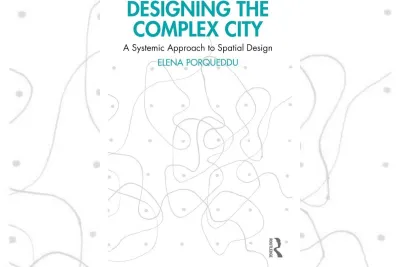
Book review: “Designing the Complex City: A Systemic Approach to Spatial Design” translates complex theory into actionable tools for planners, architects and more.



This review is part of a special collaboration between Planetizen and Booked on Planning, a biweekly podcast where AICP planner Stephanie Rouse and Jennifer Hiatt chat with authors of the latest books shaping urban planning today. Listen to the episode with today’s author in the player below.
Elena Porqueddu’s “Designing the Complex City: A Systemic Approach to Spatial Design” offers a recalibration for the built environment professions — planners, landscape architects, architects and interior designers. For decades, urban planning has oscillated between two equally flawed theories: the heavy-handed, top-down master plan that doesn’t allow for spontaneous activities, and the hands-off, market driven approach that abandons vulnerable areas to urban decay. Porqueddu cuts through this false dichotomy with a new theory: spatial design should not attempt to control the city nor abandon it. Rather, spatial design should use its self-organizing nature to guide cities through precise, systemic interventions.
What makes Porqueddu’s work stand out is its ability to translate complex systems theory, which draws from life sciences, social sciences and cognitive theory, into actionable tools for spatial designers. For those that have read “Multisolving: Creating Systems Change in a Fractured World” by Elizabeth Sawin, Porqueddu’s book takes the idea of systems thinking in spatial design a step further and applies the concepts directly to the built environment.
Porqueddu presents spatial design as a way to create “good perturbation,” or positive small changes, and recommends making a “living atlas” to transform abstract ideas into tangible methodology. Her idea of the living atlas goes beyond just mapping various layers of information: it also emphasizes keeping this information up to date and tracking how the small changes are impacting the urban environment in larger ways.
Porqueddu shows architects, landscape architects, interior designers and urban planners how to spot hidden leverage points where modest, highly targeted interventions can break the cycles of stagnation and jumpstart organic revitalization. One challenge that remains unclear in her concept is how design professionals can remain engaged with the communities after implementation when the resulting design work is largely completed by out of town design firms.
The book particularly shines in its cross-disciplinary vision. Rather than treating interior design, building design, landscape and urban planning as isolated silos, Porqueddu shows how these disciplines can act as complementary layers within a single, adaptive ecosystem. Case studies provide real life examples of her theoretical arguments, proving that open-ended, incremental design does not diminish the designer’s agency. Instead, it can amplify their long-term impact. None of the case studies took place in North America, so it will be interesting to see how these concepts stand up against a more regulated development environment and what changes are necessary to accommodate a more integrated and incremental development process.
“Designing the Complex City” provides a thoughtful roadmap from an academic lens for creating cities that are resilient, flexible and responsive to the messy but wonderful reality of human life.
Reigniting the city-building revolution
Review: In “The Unfinished Metropolis," Benjamin Schneider argues for us to look abroad for help in returning to a long-lost American art: city-building.

A masterful, human-centered defense of rent control
Book Review: "Fortunate People in a Fortunate Land" offers a human look at how rent control is more than just numbers and data in a spreadsheet.

Are cities at risk of losing squirrels?
Book review: A common backyard forager could be in decline, but without the proper data we may not know until it’s too late. Nancy Castaldo’s "Squirrel" urges us to find out.

Planetizen Federal Action Tracker
A weekly monitor of how Trump’s orders and actions are impacting planners and planning in America.

Eastern Nebraska is running out of electricity
Data centers and electrification are straining eastern Nebraska’s grid, throttling economic development.

Study reveals best places in the U.S. for cycling, walking
New research from Streetlight Data examines bicycle and pedestrian miles per capita in the 100 largest U.S. cities by population.

Next-generation nuclear reactors are coming to Texas
The reactors will not require towering containment structures thanks to new safety features.

California distributes $1.3 billion to prevent transit service cuts, bolster projects
Twenty-eight projects across California received a portion of the funding.

Pennsylvania Democrats have 15 affordability, clean energy bills for flipped state Senate
Bills in consideration include a bill supporting geothermal energy and a bill supporting solar on warehouses.

FREE Course: Walkable City 1: Why Walkability?
After describing his path towards focusing on walkability as the essence of good planning, Jeff Speck marches through his five principal reasons for making more walkable places.
Reinventing Malls: Planning Alchemy—Turning Gray Fields Into Gold
The course focuses on the opportunities and imperatives that shape reinvention of mall sites.

City of Charlotte
City of Rosemead
Rutgers University, Edward J. Bloustein School of Planning and Public Policy
University of Michigan School for Environment and Sustainability (SEAS)
Hunter College, City University of New York (CUNY)
The Architects Foundation
City of Cambridge
The Pocatello Development Authority
The Urban Renewal Agency of the City of Pocatello

