"Waymo, city officials, and urbanists have common cause."


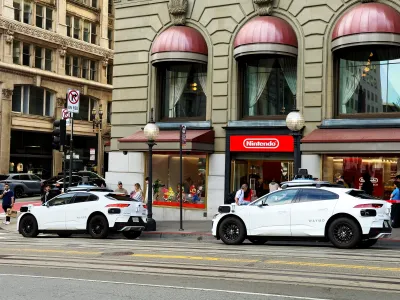
Amidst a tsunami of tepid coverage of Waymo's glitchy country-wide rollout and fears that circling empty robotaxis will skyrocket vehicle miles travelled, a Waymo employee is speaking out — on the urbanist activism site Streetsblog, no less.
A recent Streetsblog op-ed from Arielle Fleisher, policy development and research manager at Waymo, makes the case that Waymo and urbanists want the same thing: safer streets, and fewer vehicle miles travelled.
"A recent study from Open Plans and the Transportation Research Program at Hunter College argued that AVs will generate excessive 'deadheading,' or empty vehicle miles, in New York City. The concern is fair, but the conclusion was based on a false equivalence: it treats the density of California as directly comparable to New York City. The literature is clear that deadheading depends on demand density. There are fewer empty miles when cars don’t have to travel far to find their next passenger," Fleisher writes.
She goes on to assert that her personal activism in cycling and active transportation is precisely what brought her to work at Waymo in the first place, claiming that the fleet operator is just as incentivized as activists to keep empty miles down.
"Cities become more delightful when there are fewer cars circling and less curb space devoted to vehicle storage. Right now, roughly 40 percent of ride-hailing miles are empty, a figure that generally holds for AV fleets. But as a fleet operator, Waymo is incentivized to minimize deadheading because we bear the cost of every single empty mile driven. Every unnecessary mile means additional operating costs, energy consumption, vehicle wear, and risk exposure. Traditional ride-hailing platforms don’t internalize these costs; they are pushed onto the drivers. Waymo, like cities, wants to reduce empty miles as much as possible."
Her op-ed explores solutions to deadheading and implores closer collaboration with urbanists, claiming that "Waymo, city officials, and urbanists have common cause, and we don’t have to wait to start having these conversations."
Read her full argument at the link below.
Read the full story: Waymo Speaks: We Have More In Common With Urbanists Than You Might Think

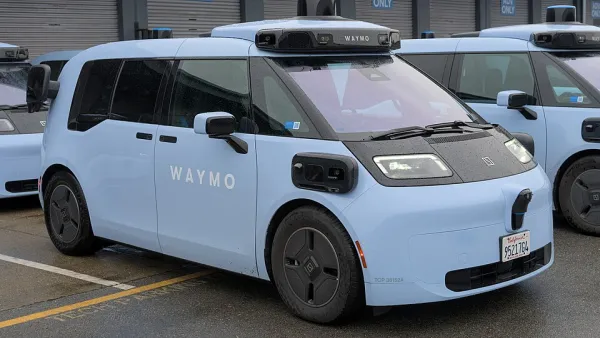
Waymo’s Ojai robotaxis from China now able to pick up all riders
Steep tariffs and tight federal laws haven’t stopped Waymo from purchasing over 3,200 vehicles from Zeekr, a Chinese manufacturer.
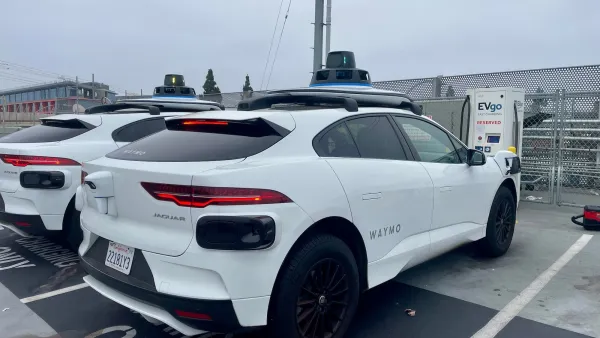
Judge orders Waymo to stop using 2 Santa Monica charging stations after noise complaints
Neighbors have asked the city to ban the company from using charging stations in residential areas between 11pm and 6am.
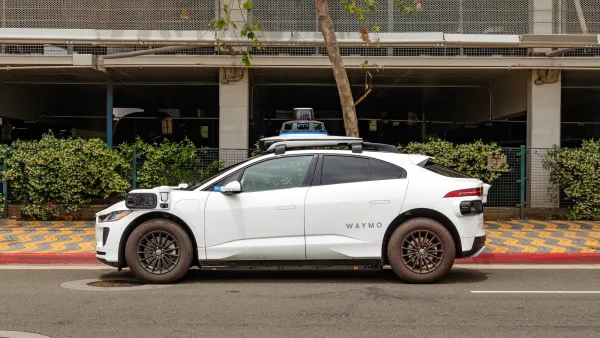
Austin Waymos rack up nearly $10k in parking tickets
The robotaxis have been cited for parking in tow zones and double parking, among other violations.

Planetizen Federal Action Tracker
A weekly monitor of how Trump’s orders and actions are impacting planners and planning in America.

‘Going backwards:’ Baltimore mayor, students rally against state's transit funding plan
Maryland's proposed six-year plan provides no funding for Baltimore’s BMORE bus program and reduces its road maintenance funding.

Detroit to transform waterfront with $2.2 billion investment
Developers will convert about 18 acres of unused parking lot space into civic spaces.

LA to transform part of water treatment facility into new park
By rebuilding some of the Los Angeles-Glendale Water Reclamation Plant’s infrastructure, the city will free up 18,000 square feet to create a new green space for the public.

San Antonio approves $1.1 billion transit agenda
The agency has also begun construction of its Via Rapid Green line, which will service passengers from the San Antonio International Airport.

Guerilla urbanists’ DIY benches joined by sanctioned seats in Chicago
The group behind the original homemade benches said they will continue installing them across bench-less bus stops in Chicago.

FREE Course: Walkable City 1: Why Walkability?
After describing his path towards focusing on walkability as the essence of good planning, Jeff Speck marches through his five principal reasons for making more walkable places.
Reinventing Malls: Planning Alchemy—Turning Gray Fields Into Gold
The course focuses on the opportunities and imperatives that shape reinvention of mall sites.

One Hundred Miles
County of Mendocino
planning NEXT
The Architects Foundation
University of Cincinnati Online
Montrose County
Northern Illinois Transit Authority (NITA)
The Pocatello Development Authority