Ground Truth, created by Brooklyn artist Justin Blinder, slows bikes down to make cyclists feel the burden of high rent.


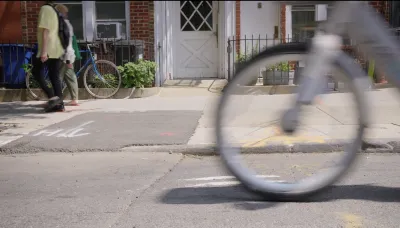
Artist Justin Blinder aims to make the burden of high rent palpable with a new device called Ground Truth — a gadget that can be attached to any bicycle to cause it to slow down through rent-burdened neighborhoods, making them physically harder to move through.
Blinder, a Brooklyn artist and contractor at Meta, built the gadget to cross reference location information with household economic data from the US Census Bureau’s American Community Survey, which is stored on the device, reports Wired. He attached the device to NYC Citi Bikes for a video project (no, he didn't slow down publicly-used Citi Bikes) and rode them through the city to illustrate the physical manifestation of the disparity.
"Ride past an economically well-off block, and the bike is easier to pedal. Going past a block where rent takes the bulk of the households’ incomes can slow the bike down to a crawl... When the bike passes a block the dataset says has a higher percentage of rent insecurity, the microcontroller triggers a small motor that applies the brake to add resistance, and the bike gets physically harder to pedal," Wired reports.
Blinder also hopes the project will also call attention to the rising cost of renting a Citi Bike, which has raised its prices for the past five years in a row.
Full story below.
Read the full story: This Art Project Slows Down Citi Bikes to Make NYC’s Rent Crisis Feel Real
To upzone or not to upzone? Two views on the housing crisis
Allowing more density can increase the housing supply, but does the attendant rise in land prices cancel out the benefits?
Controversial Texas housing law has 'directly facilitated' over 1,250 new homes
SB 840 allows developers to build multifamily housing by-right on lots zoned for commercial use without applying to a zoning change.
California sues 5 cities over housing goals
Costa Mesa, Half Moon Bay and Ridgecrest are among the cities that the state is taking action against for failing to plan for adequate housing needs.

Planetizen Federal Action Tracker
A weekly monitor of how Trump’s orders and actions are impacting planners and planning in America.

Eastern Nebraska is running out of electricity
Data centers and electrification are straining eastern Nebraska’s grid, throttling economic development.

Study reveals best places in the U.S. for cycling, walking
New research from Streetlight Data examines bicycle and pedestrian miles per capita in the 100 largest U.S. cities by population.

DSA members accuse Mamdani of 'abandoning values' over housing redevelopment
New York City's mayor plans to replace about 2,000 units of public housing with private, mixed-income housing.

All sides of BRT debate unhappy with CDOT’s most recent move
The Colorado Department of Transportation is no longer considering center-running bus lanes for Colorado Boulevard.

Massachusetts bogs generate both power, and cranberries
Putting solar panels above farmland is one way Massachusetts is advancing toward its goal of net-zero carbon emissions by 2050.

FREE Course: Walkable City 1: Why Walkability?
After describing his path towards focusing on walkability as the essence of good planning, Jeff Speck marches through his five principal reasons for making more walkable places.
Reinventing Malls: Planning Alchemy—Turning Gray Fields Into Gold
The course focuses on the opportunities and imperatives that shape reinvention of mall sites.

City of Rosemead
Rutgers University, Edward J. Bloustein School of Planning and Public Policy
One Hundred Miles
University of Michigan School for Environment and Sustainability (SEAS)
Hunter College, City University of New York (CUNY)
The Architects Foundation
City of Cambridge
The Pocatello Development Authority
The Urban Renewal Agency of the City of Pocatello