The freeway cap project, approved and funded under the Biden administration, is now in jeopardy after the federal government rescinded all but $8 million in funding.


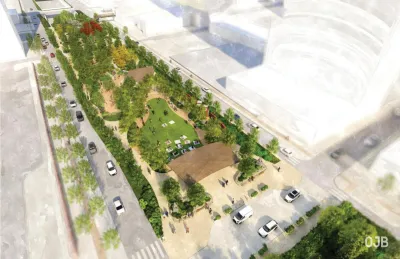
Community leaders and city officials in Philadelphia are rallying to save a proposed freeway cap that would reduce pollution and improve connectivity in the city's Chinatown neighborhood.
According to an article by Daniel Perrin in Inside Climate News, "Today, more than 100,000 vehicles use the expressway (I-676) every day, bringing pollution and noise with them, and the highway’s acres of cement intensify hot temperatures and limit mobility and public space in the neighborhood."
The city then received several federal grants totaling over $2 billion to build the Chinatown Stitch, a freeway capping project that would move some traffic to an at-grade boulevard and build a park over two and a half blocks of Interstate 676. Now, the Trump administration has rescinded all but $8 million in funding, putting the project in jeopardy.
Local leaders are coming together to find new funding for the project. "Earlier this year, the Delaware Valley Regional Planning Commission awarded $10 million in tandem with $2.5 million from the city of Philadelphia to get the project 'shovel-ready.'" But ultimately, the project needs funding from Washington to move forward. Supporters hope lawmakers can still add funds for the Stitch and similar projects to the BUILD America 250 Act, which doesn't currently include funding for freeway capping projects.
Read the full story: In Philadelphia’s Chinatown, a Fight to Restore Funding for a Critical Highway Cap
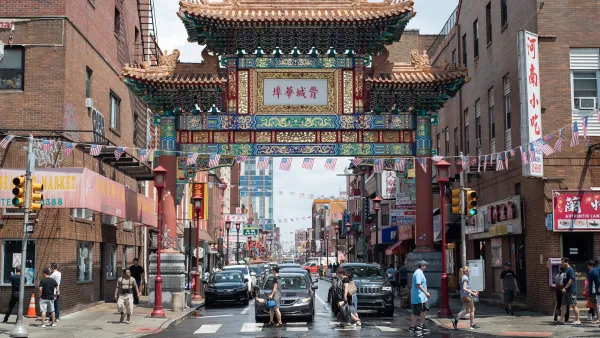
Philadelphia’s ‘Chinatown Stitch’ Freeway Cap in Danger After Feds Retract Funding
A project 15 years in the making would reconnect Philadelphia’s Chinatown neighborhood after decades of being split in half by a roadway.
Dead End: Nine Highways Ready for Retirement
The Freeways Without Futures report describes the nation’s most promising highway removal proposals.
Congress Moves to End Reconnecting Communities and Related Grants
The House Transportation and Infrastructure Committee moved to rescind funding for the Neighborhood Equity and Access program, which funds highway removals, freeway caps, transit projects, pedestrian infrastructure, and more.

Planetizen Federal Action Tracker
A weekly monitor of how Trump’s orders and actions are impacting planners and planning in America.

California plans to bury El Niño’s downpour
If the state plays its cards right, it may be able to store a billion acre-feet of El Niño’s water in aquifers.

Desperate measures: Advocates weigh draining Lake Powell to fill Colorado River
Draining the reservoir could reduce evaporation losses by a couple hundred thousand acre-feet.

US buildings threatened, destroyed by fires set to triple by 2060
Researchers found a high fire risk for socioeconomically vulnerable neighborhoods in the American West.

LA residents may be allowed to paint their own crosswalks
Councilwoman Katy Yaroslavsky put out a motion instructing the Los Angeles Department of Public Transportation to study the feasibility of allowing volunteers to paint crosswalks.

Dallas moves to overhaul its zoning code
The city's zoning reform will allow more multi-family and mixed-use developments.

FREE Course: Walkable City 1: Why Walkability?
After describing his path towards focusing on walkability as the essence of good planning, Jeff Speck marches through his five principal reasons for making more walkable places.
Reinventing Malls: Planning Alchemy—Turning Gray Fields Into Gold
The course focuses on the opportunities and imperatives that shape reinvention of mall sites.

City of Rosemead
Rutgers University, Edward J. Bloustein School of Planning and Public Policy
One Hundred Miles
Hunter College, City University of New York (CUNY)
The Architects Foundation
University of Cincinnati Online
City of Cambridge
Montrose County
The Pocatello Development Authority