After nearly a decade working in urban planning, I've surmised that power, more than policy, lies at the heart of our deepest planning dysfunctions. Let's talk about it.



This article is part of a regular column by Chicago-based transit planner extraordinaire Joshua Woods, who authors Thoughts About Cities. Check out his popular 2025 series, Transit Planning 101, and its follow-up sibling, Transit Scheduling 101.
"Instead of addressing the root of these problems, political power brokers find the 'solution' that polls the best or masks the most pronounced symptoms, leaving the underlying problem to fester. Let’s call this political sepsis. Until we can address political sepsis, I’m not sure we’ll be able to see housing affordability… or good governance at all."
- Me, in an article about zoning, of all things
When I first began working on my master’s degree in Sustainable Urban Development, I was guided by one central question: How do cities work? I thought that with a sound understanding of how cities work, we could build the "correct" policy environment, and in that correctness, many of the woes facing cities would resolve themselves. If we just modernize dated zoning codes and eliminate parking minimums, housing would suddenly become affordable, and walking or biking to work, school or the neighborhood coffee shop would become an option for everybody, not just a luxury reserved for the most affluent communities.
After working as an urban planner for a while, I’ve come to realize two critical shortcomings with this thinking.
First, cities are complex, not complicated. There’s a whole lot going on, and no matter how much we study them, we can never fully understand the universe of individual interactions and their outcomes. This complexity means that there is no such thing as the "correct" policy environment. There are plenty of best practices, but the "correct" solution is as varied as cities themselves — and the people that call them home.
Second, this thinking completely negates the role that power plays in cities.
What is power?
Power (n) - The capacity to compel one or many into acting or behaving in a certain way.
Power is an inescapable force that governs how we engage with the world around us. However, whereas gravity is a natural force created by the earth itself, power is a social force. Most of the power that shapes our lives today is generated and brokered by people and the institutions they build.¹ People with diverse intentions, altruistic and otherwise, see the potential boodle to be gained from manipulating power, so they work to understand it. This bisects the population into two groups:
- Those attempting to broker power.
- Those having power brokered over them.
Being downstream of a power broker, even a malicious one, is not an intrinsically bad position. From this vantage point, you get a case study in how and why power is leveraged and what assumptions are made in maintenance of that power. By watching quietly, you can start to pick up a key building block of power: information.
Being downstream of a power broker becomes a huge problem if you can’t notice when power is being leveraged. And if the broker is any good at dealing in power, they’re probably actively or subconsciously trying to hide it.
Types of power
💪🏽 Physical power
The series "The Siege of Chicago" documenting ICE activity in the city, offers a view of one of the most carnal forms of power, physical power. Physical power is the use of force to compel one or many into or behaving in a specific way. Although we’re currently seeing this power being wielded by the highest forms of government, public displays of physical power are relatively uncommon. Physical power is often used in response to (or to create) flashpoints, or in endgames, but since it’s amongst the most visible and emotionally visceral forms of power, people and institutions attempting to maintain power typically only employ the use of physical power sparingly. The optics are awful, and in an attention economy, optics can carry as much power — if not more — as reality.
Asserting physical power over someone is also just plain bad, but that’s a moral statement. Power doesn’t really care about morals. Power is just easier to broker when it looks moral.
Since the actions documented in "The Siege of Chicago" involve the government exerting power, they also represent an example of institutional power.
🏦 Institutional power
Institution (n) - An organization, system, or practice, often human-made, that plays a significant role in the structure or functioning of society
Institutional power refers to instances when an institution uses its vested authority to compel individuals to make a decision, or when an institution makes a decision on behalf of its constituents that they can’t reasonably opt out of. Taxes and zoning are examples of institutional power, for better or for worse.
Some level of institutional power is necessary for any institution to carry out its core functions. Governments need to collect taxes if they’re expected to deliver public services. Companies need to establish internal policies that align with their business needs. However, institutional power is ultimately administered by people, and people are subject to their own incentives and agendas. This excerpt from "Don’t Make No Waves…Don’t Back No Losers," a 1975 analysis of Chicago machine politics, provides insight on the motives and mechanics of co-opting institutional power for individual gain:
"The men who dominate the organization are practical, pragmatic, parochial, and non-ideological. Their primary concern is their own self-interest. This is not to say that they have no concern for the public good, but rather that that concern is secondary to their own interests.
In this they are no different from businessmen, doctors, lawyers, or academicians, except that politics is their business. Since they seek and hold public office, however, they are expected by those who put them into office to concern themselves with public problems and the interests of society rather than with their own private interests, and to get into office they must pledge themselves to a pursuit of the common good.
However, once in public office, the human, private concerns of the public servant assert themselves. How to pursue his private interests while at the same time convincing the electorate that he is pursuing the public interest is the major task of a politician, particularly in a democracy, where the sovereign voters have the power to arbitrarily bring his career to a sudden end."
In July 2025, the Chicago City Council voted unanimously to remove parking minimums near transit. The very same day the ordinance passed, Alderman Pat Dowell of Chicago’s 3rd Ward quietly introduced an ordinance exempting developments adjacent to the chunks of bus routes in her ward from having to comply with the new ordinance. Notably, this exemption included sections of routes on the frequent network, a subset of routes being targeted for frequency, span and reliability improvements. While the ordinance did not move out of committee, it represents an interesting case study for what it can look like when best practices clash with institutional power structures.
Chicago is subdivided into 50 wards, with each ward represented by an elected alderman. Aldermen are expected to represent citywide interests as one of the 50 members of the Chicago City Council. Reducing or eliminating parking minimums near frequent transit and replacing it with more productive land uses sets off a virtuous cycle that makes transit more useful, productive, cost effective and resilient against changes in travel patterns.²
However, aldermen are elected by the residents of the ward they represent, whose localized interests might not align neatly with the overall interests of the city. A ward resident who drives to 90% of the places they go may not be keen to support a policy that could threaten the availability of parking in the ward, even if it comes with the benefit of a more resilient transit system. Depending on the perceived composition of the ward's voting population, aldermen can have a strong incentive to put ward interests above citywide interests and best practices. After all, it is residents of the ward who get to decide if the alderman keeps their job come the next election.
Control versus influence
You have control over the things whose outcomes you can directly determine. In practice, you are the only thing you have total control over. You only have influence over everything else. This does not mean that influence is not powerful. Arguably, influence can be more powerful than control. Influence, if strong enough, can get the same results as control with the added advantage of obscuring who is wielding the power.
Influence relies on understanding how people will react to things generally³, and leveraging those reactions to an end. The internet — namely, its capacity to connect people, thoughts and ideas across the globe instantaneously — has supercharged the power of influence, and people that care to broker power are "stat-maxxing."
Want to sell an unpopular policy like a tax increase? Attach an emotional appeal to it, let the internet run for a while and play whatever angle polls the best.
Want to get people stirred up, agitated and confused generally? Flood the airwaves with more information than anyone can possibly process. Keep going if you want people to eventually check out.
Want to seed infighting to divide and conquer? Feed people algorithmic content reminding them whom to hate, and who will save them from that evil person. Pretty soon, everybody will be so preoccupied with hating one another that you can do whatever you want.
If any of those scenarios feel vaguely familiar, explore that! It could be your lens into understanding the power relations around you.
"How we live is so different from how we ought to live that he who studies what ought to be done rather than what is done will learn the way to his downfall rather than to his preservation."
- Niccolo Machiavelli, The Prince
A lesson from board games
When I visit my in-laws, we love playing board games. Lords of Waterdeep, an open-ended strategy game set in the Dungeons & Dragons universe, is one of our personal favorites. In the game, players take on the roles of secret rulers vying for control of the city of Waterdeep by constructing buildings and completing quests. Both require resources represented by coins and colored cubes that can be collected by landing on spaces throughout the board. For example, if you needed money, you’d probably want to go to Aurora’s Realms Shop and pick up four gold pieces.

The Scoundrels of Skullport expansion to the game introduced the corruption track. This added spaces like the Hall of The Voice, where a player can pick up five gold pieces, as well as a quest card and an intrigue card, which gives you a one-time special ability.
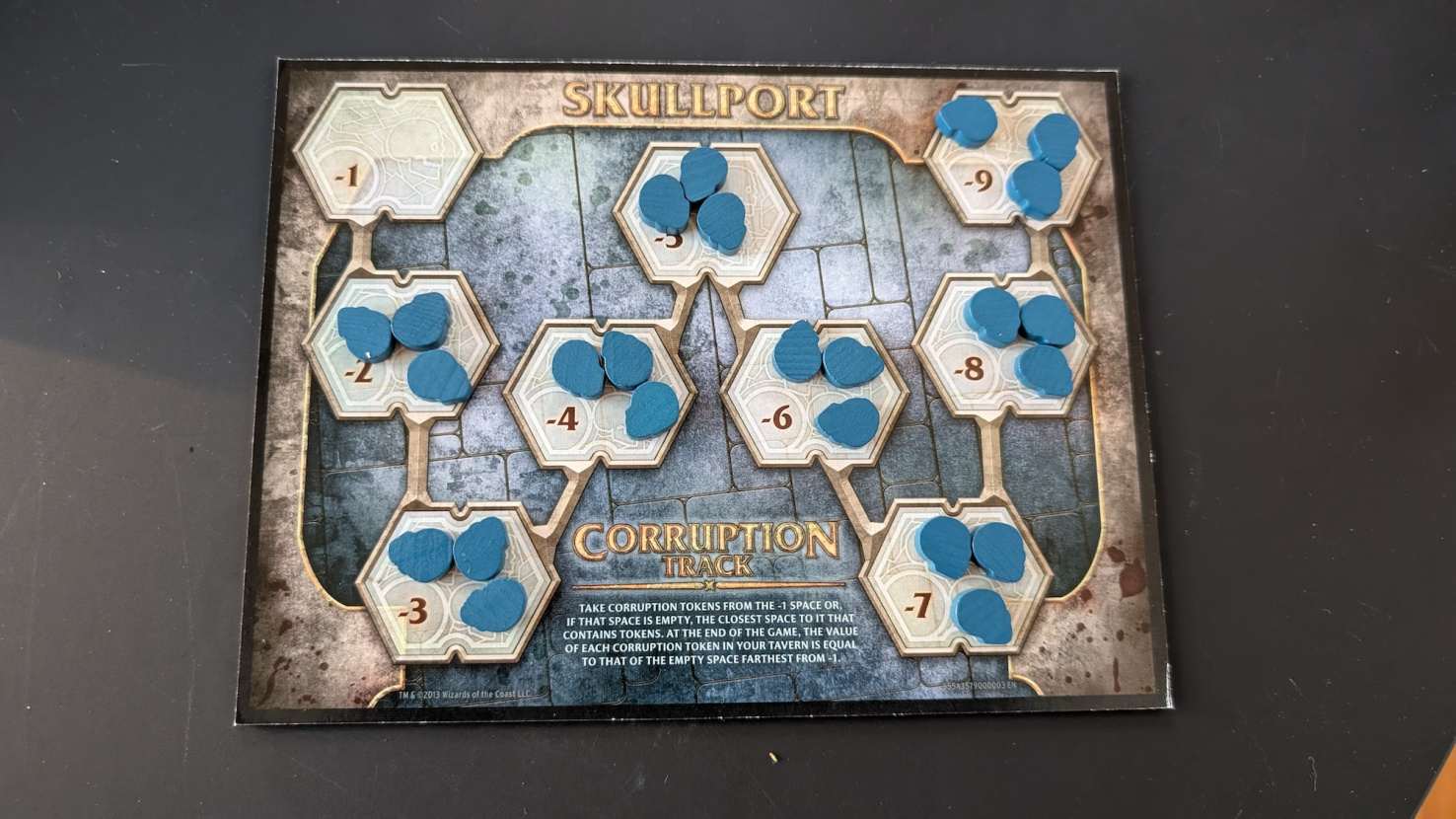
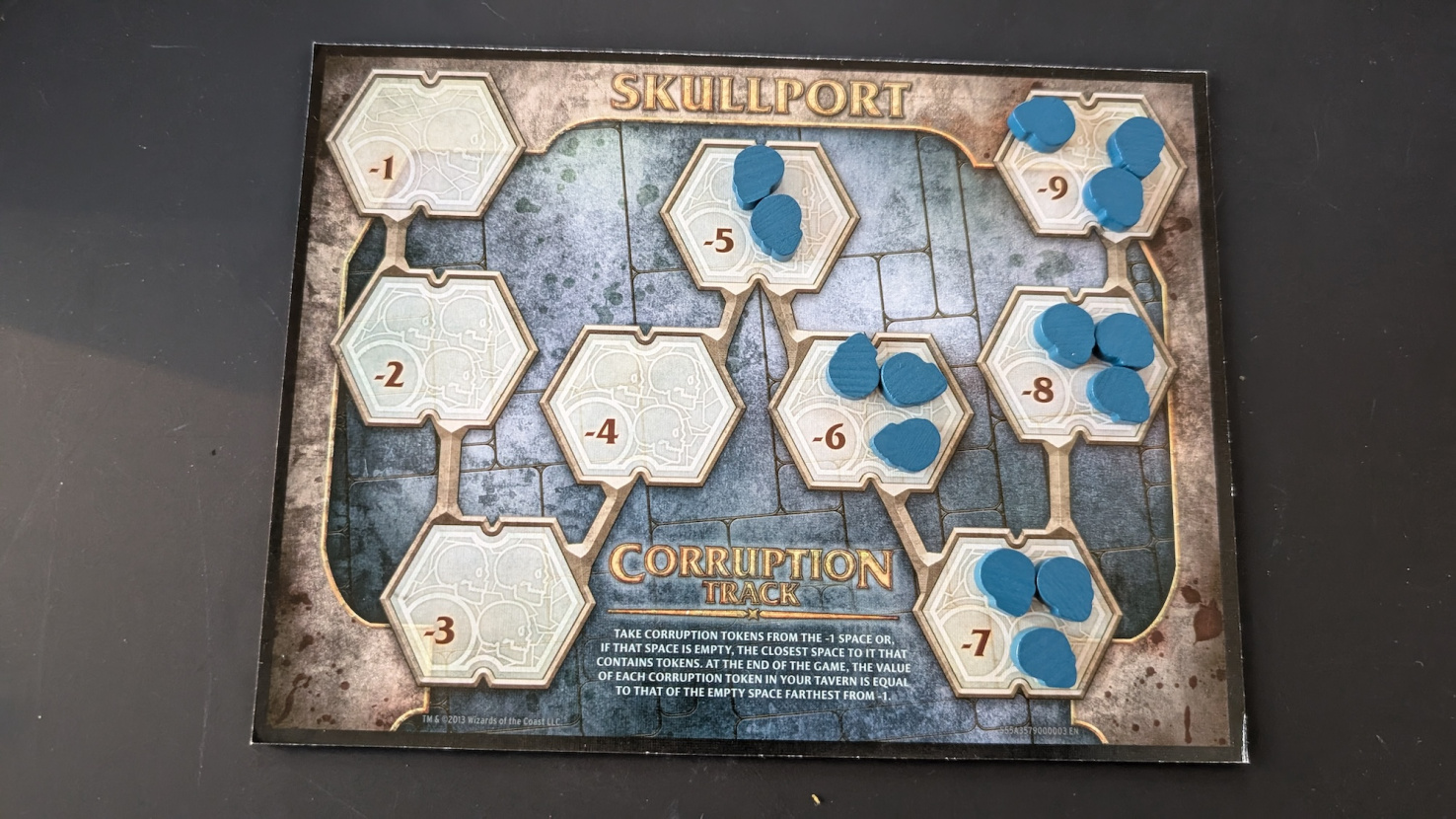
 For all of this boodle, the player also has to pick up a skull from the corruption track. If not disposed of by the end of the game, these skulls take away from the players' final score, based on how many points have been taken from the corruption track, and how many skulls they still have.
This person would lose one point per skull at the end of the game:
 This person would lose four points per skull:
 The corruption track in Lords of Waterdeep offers a decent analogy for the use of power.
If power is used to acquire something already within your reach, there’s nothing to note. Keep playing the game. If power is used to acquire something beyond your reach, keep playing, but go ahead and pick up a corruption point. You cheesed the system. If you pick up corruption points once or twice, you’ll probably be fine by the end. However, if you make a habit of picking up corruption points without a plan to mitigate them, it’s going to cost you at the end of the game.
With that in mind, let’s close with some themes I’ve noticed from my short time observing power.
- Absolute power corrupts absolutely. I know this is a tired adage, but I’ve found it to be true. When people get power, it changes their worldview, sometimes significantly. This can make people think and act in ways foreign to past versions of themselves.
- Fear is powerful. People are less likely to defy a person or institution they are afraid of. Even when they do, fear puts people in an emotionally heightened state that handicaps their ability to think rationally. Fortunately, power held through fear is hard to maintain. It creates enemies.
- Distraction can be more powerful than fear. Fear creates enemies. Distraction checks people out. Once people are checked out, if the backdrop of life (real or perceived) gets particularly bleak, what reason do people have to check back in?
- Once people and institutions gain power, they are generally reluctant to cede it. However, when questioned about the power they hold, most people and institutions interested in maintaining power downplay the power they actually have to keep expectations low.
- Power is always in flux. When a person with power leaves their post, this leaves a power vacuum. Power vacuums never last long. Somebody is always angling for that seat. In the immediate aftermath of a power vacuum, it’s always worth noting who was first on the scene to fill it.
Power may sound like an out of place concept to discuss on an urban planning website, but planners sit at a significant intersection of public policy and the complexity of life. Remember, zoning is an example of institutional power. If somebody wants to build an ADU in their backyard, perhaps to house their aging mother closer to home, it's the planners at the zoning commission — institutional power — and not the police force — physical power — that decide whether the project can move forward.
¹ Sure, a bear has the power to kill and eat you, but is that an incredibly relevant concern in day to day life?
² The good folks over at the Parking Reform Network have tons of resources to learn about parking minimums and how they impact development. If you’re looking to take a deep dive, The High Cost of Free Parking by Donald Shoup is the pinnacle work on the topic (It’s also 700+ pages. Here’s a cheat sheet).
³ You don’t need influence over everybody to have significant influence.


California Developments Wait Months for Power
In areas served by PG&E, new developments sometimes have to wait months before the utility will turn on the power, creating extra costs for builders and keeping new affordable housing units off the market.

U.K. Solar Trains to Embark in August
South Western Railway will be using its own solar panels to directly supply power to trains and partially eliminate its need for outside power.

Editorial See Ulterior Motives in Recent Hetch Hetchy Discussion
There have been multiple movements to remove the Hetch Hetchy Reservoir, but the most recent flirtation with the idea comes from Interior Secretary Ryan Zinke. A Chronicle editorial argues Zinke's interest lacks good faith.

Planetizen Federal Action Tracker
A weekly monitor of how Trump’s orders and actions are impacting planners and planning in America.

Amtrak, CN end decades-long dispute with eight-year agreement
The new operating agreement establishes an updated framework for the companies to work together, including processes to resolve disputes.

Northwest rail fans eager for Sept. 30 debut of Amtrak’s Airo fleet
Get ready for that new train smell and more seats. But they won’t go faster or run more frequently on the Cascades route in Washington and Oregon.

Trump administration unlawfully slashed $7 billion in clean energy grants, judge rules
The Environmental Protection Agency ended the Solar For All program, which provided the grants, after President Donald Trump’s inauguration.

Record-breaking wildlife overpass in Colorado brings 91% reduction in animal collisions
Prior to the overpass, vehicles were hitting one deer per day on Colorado’s Interstate 25.

California lawmakers approve just 5% of much-needed LA28 transportation funding
State legislators appear just as unwilling as Trump to pay for Olympics-related transportation projects.

FREE Course: Walkable City 1: Why Walkability?
After describing his path towards focusing on walkability as the essence of good planning, Jeff Speck marches through his five principal reasons for making more walkable places.
Reinventing Malls: Planning Alchemy—Turning Gray Fields Into Gold
The course focuses on the opportunities and imperatives that shape reinvention of mall sites.

City of Thousand Oaks
City of Wisconsin Rapids
Harvard University Graduate School of Design
The Architects Foundation
University of Cincinnati Online
The Pocatello Development Authority
The Urban Renewal Agency of the City of Pocatello

