The city is taking more aggressive measures to prevent skateboarders from using unsanctioned public spaces.


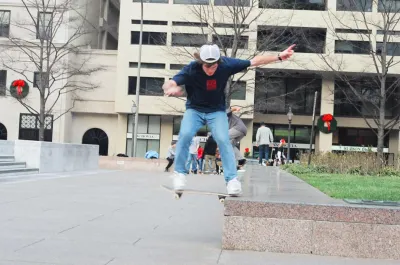
President Trump's efforts to change D.C. landmarks is restricting access to some popular skateboarding locations, writes William Clarke IV in 730DC.
One such site is Freedom Plaza, also known as Pulaski Park, which has played host to a bevy of well-known skaters. "But the plaza closed for construction in December, and metal fixtures have since been bolted onto the ledges, rails, and fountain encasements to prevent grinding. Around the same time, fences went up around two other popular skate spots: the long-empty fountains at Malcolm X Park and an underpass in Navy Yard on Half Street SE."
The renovations are a response to President Trump's March 2025 order to "beautify" Washington D.C. landmarks, which has "accelerated the erasure of informal skating spaces that made Washington, D.C., one of the East Coast’s premier skate destinations."
Clarke notes that the District is expanding its network of sanctioned skate parks, but for many skaters, that misses the point. According to Clarke, "The sanctioned parks were never interchangeable with the open public spaces skaters claimed. They haven’t been core to D.C.’s skate identity for decades, like Freedom Plaza. They rarely offer the chance for something new and unexpected, like Malcolm X Park. You can’t replace a landmark with a facility."
Read the full story: How ‘beautification’ threatens DC’s treasured skate spots

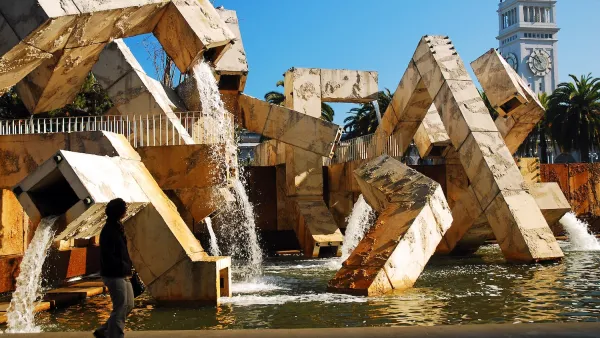
San Francisco to Dismantle its Polarizing Brutalist Fountain
The Vaillancourt Fountain stands as a symbol of the tension between the city’s past and future.

Third Spaces and Public Life
Public parks, libraries, and other social infrastructure foster community connections and stave off loneliness. Why are they increasingly deprioritized in civic life?

Schoolyards as a Solution for Park-Poor Cities
Opening schoolyards to the public could be 'game-changing' for communities lacking in green space.

Planetizen Federal Action Tracker
A weekly monitor of how Trump’s orders and actions are impacting planners and planning in America.

California plans to bury El Niño’s downpour
If the state plays its cards right, it may be able to store a billion acre-feet of El Niño’s water in aquifers.

Chicago breaks ground on $3 billion megadevelopment
The new neighborhood, titled Foundry Park, will one day host 3,700 residences.

California High-Speed Rail Authority CEO resigns after $600,000 scandal
Under Ian Choudri, the authority used taxpayer dollars to fund first class flights and trips to nightclubs.

Want to study the Missouri River? Soon, you may need unanimous approval from 10 states
Legislation would require 10 governors’ permission to study or build projects moving water outside the basin.

Desperate measures: Advocates weigh draining Lake Powell to fill Colorado River
Draining the reservoir could reduce evaporation losses by a couple hundred thousand acre-feet.

FREE Course: Walkable City 1: Why Walkability?
After describing his path towards focusing on walkability as the essence of good planning, Jeff Speck marches through his five principal reasons for making more walkable places.
Reinventing Malls: Planning Alchemy—Turning Gray Fields Into Gold
The course focuses on the opportunities and imperatives that shape reinvention of mall sites.


City of Rosemead
Rutgers University, Edward J. Bloustein School of Planning and Public Policy
One Hundred Miles
Hunter College, City University of New York (CUNY)
The Architects Foundation
University of Cincinnati Online
City of Cambridge
Montrose County
The Pocatello Development Authority