The new ordinance allows the city to delay implementing SB 79, a state law requiring more density near transit.


The Los Angeles City Council approved a "Low-Rise Ordinance" aimed at delaying SB 79, a state law that requires cities to upzone areas for more density near transit, reports David Wagner for LAist. SB 79 allows apartment buildings up to nine stories near train and bus rapid transit stops, but lets cities delay its implementation until 2030 if they submit other proposals for increasing the housing supply in the meantime.
The new LA law allows buildings up to four stories tall near transit stops in 57 of the city's neighborhoods and "aims to delay full implementation of SB 79 in areas deemed historically significant, at high risk of fires or economically 'low resource.'" Proponents of the plan say some areas are not currently suitable for new development and that forcing growth could have "unintended consequences."
The plan will return to the council for another vote before going to Mayor Karen Bass for final approval.
FULL STORY: LA passes plan for new ‘low-rise’ housing, delaying state law that aims higher

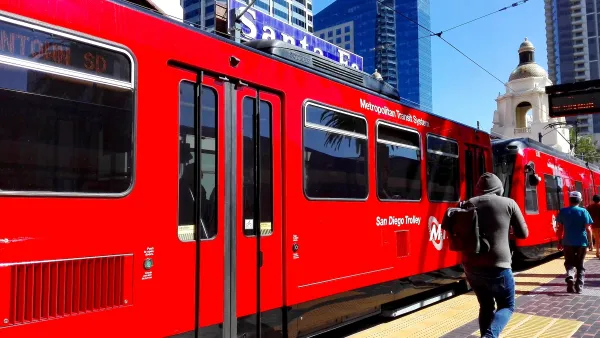
San Diego wants to limit upzoning law to just 16% of transit-adjacent parcels
The city's planning director says some areas are unfit for immediate upzoning due to a lack of resources or hazards such as wildfire risk.

LA Metro Opposes TOD Law, Fearing Backlash to Transit Expansion
Metro wants an exemption from California’s new housing law, despite the law’s potential to increase ridership by putting more housing near transit stations.
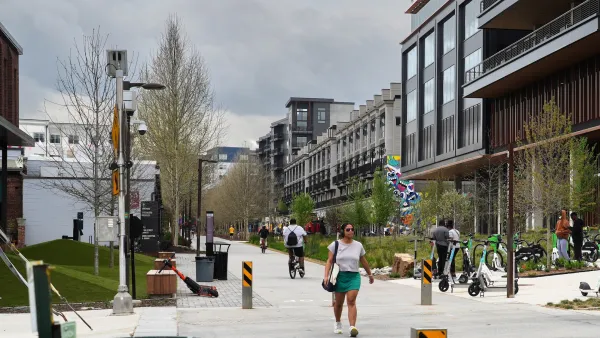
Atlanta's Beltline hits 79% of its affordable housing goal
The walking, biking, and transit corridor set a goal to create 5,600 affordable housing units in the area by 2030.

Planetizen Federal Action Tracker
A weekly monitor of how Trump’s orders and actions are impacting planners and planning in America.

The state-sanctioned urbicide of Austin
People don’t kill cities. Freeways do.

US to reduce Colorado River water deliveries to Mexico
A new Colorado Treaty amendment reduces Mexico’s Colorado River water allocation by 250,000 acre feet.

Mamdani overhauls NYC's Vision Zero plan with 100 new policy goals
The overhaul aims to reduce traffic deaths and make streets safer for pedestrians, cyclists and drivers through lower speed limits, new safety infrastructure and more.

Amtrak not solely to blame for New Jersey commuter rail's unreliability, report finds
A new study from the Garden State Initiative found that NJ Transit’s budget grew 20% across a 4 year period, but reliability declined significantly over the same period.

EPA erases limits on planet-warming pollution from power plants
Under Monday’s plan, power plants would still have some limits on how much mercury, arsenic and other contaminants they can emit.

FREE Course: Walkable City 1: Why Walkability?
After describing his path towards focusing on walkability as the essence of good planning, Jeff Speck marches through his five principal reasons for making more walkable places.
Reinventing Malls: Planning Alchemy—Turning Gray Fields Into Gold
The course focuses on the opportunities and imperatives that shape reinvention of mall sites.

Eagle County Government
Harvard University Graduate School of Design
Nashville Planning Department
The Architects Foundation
University of Cincinnati Online
The Pocatello Development Authority
The Urban Renewal Agency of the City of Pocatello
Journal of the American Planning Association