The city's planning director says some areas are unfit for immediate upzoning due to a lack of resources or hazards such as wildfire risk.



San Diego's city planning director is asking the city council to limit the application of a new state law, SB 79, to just 16% of land near transit stops.
The law is intended to push cities to update their zoning to allow for more density near transit stations, explains David Garrick in The San Diego Union-Tribune. "Under the proposal, the zoning changes would take effect immediately only in areas with high incomes and strong amenities — areas deemed most able to absorb new housing and the new residents that come with it."
The proposal would delay implementing the law in low-income areas that "lack amenities" and neighborhoods with other challenges such as high wildfire risk, historic structures or flooding risk. "Officials say the delay would give them time to either boost those low-resource neighborhoods with new infrastructure or amenities, or at least allow officials to thoughtfully pick the best spots in those areas for dense housing projects." The city's planning director, Heidi Vonblum, wants to delay upzoning in low-income areas, which make up 26% of city land near transit stops, until 2031, and in areas with other risks, which make up 52% of land near transit stops, until mid-2027. Vonblum is also asking the council to eliminate neighborhoods where barriers like freeways or canyons impede access to the transit station despite geographic proximity.
The city's planning commission disagrees with Vonblum and has asked the council to apply SB 79 in low-resource areas by 2027. "Kelly Moden, commission chair, said the city’s low-resource areas are more likely to be bolstered than burdened by housing projects allowed by SB 79, which she called potential catalysts for those neighborhoods."
The proposal will be taken up by the city council on Thursday, and their decision would require approval by the state Department of Housing and Community Development.
Read the full story: San Diego seeking delays, exemptions to new state law requiring high-rises near transit stops


LA Metro Opposes TOD Law, Fearing Backlash to Transit Expansion
Metro wants an exemption from California’s new housing law, despite the law’s potential to increase ridership by putting more housing near transit stations.
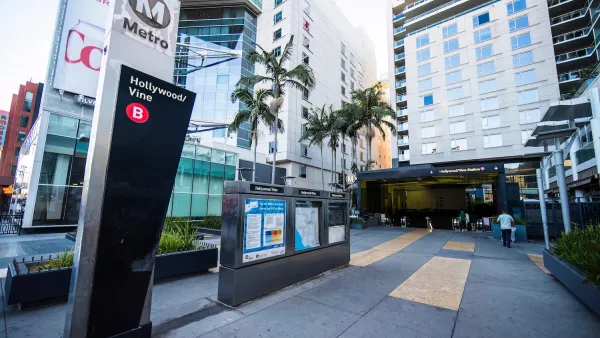
Opinion: California’s SB 79 Would Improve Housing Affordability and Transit Access
A proposed bill would legalize transit-oriented development statewide.
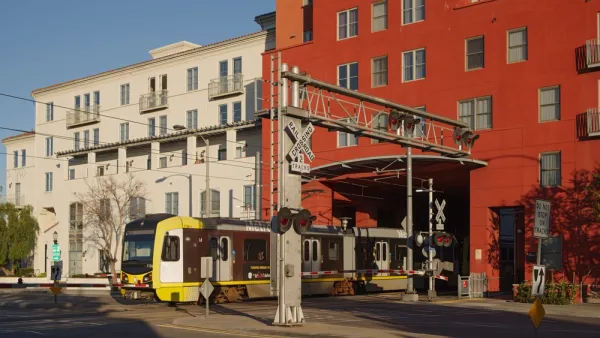
California Bill Aims to Boost TOD
A bill proposed by Sen. Scott Wiener would exempt transit agencies from zoning rules near ‘high-quality’ transit stops and allow denser transit-oriented development.

Planetizen Federal Action Tracker
A weekly monitor of how Trump’s orders and actions are impacting planners and planning in America.

California plans to bury El Niño’s downpour
If the state plays its cards right, it may be able to store a billion acre-feet of El Niño’s water in aquifers.

Chicago breaks ground on $3 billion megadevelopment
The new neighborhood, titled Foundry Park, will one day host 3,700 residences.

Satanic Place Names
From streams and lakes to valleys and canyons, I mapped more than 1,000 places named after the Devil.

California High-Speed Rail Authority CEO resigns after $600,000 scandal
Under Ian Choudri, the authority used taxpayer dollars to fund first class flights and trips to nightclubs.

Want to study the Missouri River? Soon, you may need unanimous approval from 10 states
Legislation would require 10 governors’ permission to study or build projects moving water outside the basin.

FREE Course: Walkable City 1: Why Walkability?
After describing his path towards focusing on walkability as the essence of good planning, Jeff Speck marches through his five principal reasons for making more walkable places.
Reinventing Malls: Planning Alchemy—Turning Gray Fields Into Gold
The course focuses on the opportunities and imperatives that shape reinvention of mall sites.

City of Rosemead
Rutgers University, Edward J. Bloustein School of Planning and Public Policy
One Hundred Miles
Hunter College, City University of New York (CUNY)
The Architects Foundation
University of Cincinnati Online
City of Cambridge
Montrose County
The Pocatello Development Authority