City-supported ‘multiplex’ childcare centers in commercial spaces and satellite micro-centers in rural areas are creating opportunities for small businesses and offering more flexible, accessible childcare.


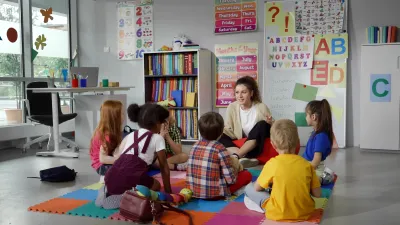
Some cities are turning underused commercial spaces or small homes into childcare centers, offering opportunities for multiple licensed family childcare providers to operate in one space, cutting costs.
As Anne Vilen explains in The Daily Yonder, “States have different regulations for and even definitions of family childcare; many explicitly or implicitly require that family childcare providers live in the residence where they care for children.” Just seven states allow family childcare providers to operate in non-residential settings.
Kansas is one of them, which has allowed creative forms of childcare centers — such as multi-business complexes and converted homes — to develop, bringing job opportunities and childcare options to residents. In Medicine Lodge, Kansas, “The Medicine Lodge Daycare flex-plex is a cluster of small, fully equipped childcare businesses in a mainstreet building” that offers spaces for five separate family childcare providers, allowing them to avoid the more onerous licensing requirements for childcare center administrators.
In rural areas, there is a greater need for smaller childcare centers serving fewer clients in remote locations. “In Indiana, the Office of Early Childhood and Out-of-School Learning (OECOSL), streamlined its licensing categories to support a Micro-Facility Pilot program that launched in early 2025. Six existing childcare centers applied to open smaller satellites in rural or small town libraries, schools, and shopping centers.”
Read the full story: Plexes, Pods, and Micro-Centers: New Family Childcare Models Are Bringing Business and Families Back to Main Street

Parking Mandates Have a New Victim: Daycare Centers
In Washington state, onerous parking requirements are a major factor in a growing childcare shortage.

Vancouver Day Care Rejection Poses Larger Questions
What does it mean for cities and civic life when neighborhoods are viewed as products geared for individual consumption rather than ever-evolving communities?
Multigenerational Households Increasingly Common in the U.S.
More American adults are living with parents or relatives, largely due to financial reasons.

Planetizen Federal Action Tracker
A weekly monitor of how Trump’s orders and actions are impacting planners and planning in America.

Amtrak, CN end decades-long dispute with eight-year agreement
The new operating agreement establishes an updated framework for the companies to work together, including processes to resolve disputes.

Northwest rail fans eager for Sept. 30 debut of Amtrak’s Airo fleet
Get ready for that new train smell and more seats. But they won’t go faster or run more frequently on the Cascades route in Washington and Oregon.

If Corpus Christi can’t revive desalination plant project, it may owe Texas $235 million
Earlier this month, city officials declined to pursue developing the plant for the second time in a year.

Brightline Florida expected to file for bankruptcy this week
The transit agency is over $5 billion in debt.

Atlanta City Council unanimously backs $3.5 billion Beltline light rail project
The resolution was drafted after Atlanta Mayor Andre Dickens pulled support for the Atlanta Streetcar extension last year.

FREE Course: Walkable City 1: Why Walkability?
After describing his path towards focusing on walkability as the essence of good planning, Jeff Speck marches through his five principal reasons for making more walkable places.
Reinventing Malls: Planning Alchemy—Turning Gray Fields Into Gold
The course focuses on the opportunities and imperatives that shape reinvention of mall sites.

City of Thousand Oaks
City of Wisconsin Rapids
Harvard University Graduate School of Design
The Architects Foundation
University of Cincinnati Online
The Pocatello Development Authority
The Urban Renewal Agency of the City of Pocatello