In Berlin and elsewhere, defunct airstrips are transformed into valuable public space.


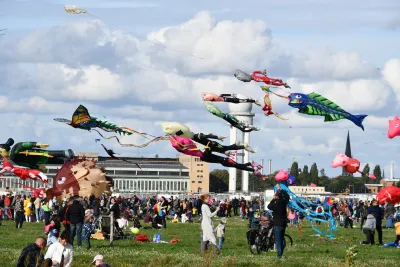
A former airfield in Berlin is now a popular public park, and other disused airports around the world could have the same fate.
MaryLou Costa describes the history of Berlin’s Tempelhofer Feld in a piece for Reasons to be Cheerful, explaining how the airfield went from prison camp to refugee waypoint before it closed completely in 2008. After the city reopened it as a park, residents voted in 2014 to preserve the space permanently for public use.
These vast spaces offer land ready for conversion to green space, particularly in dense urban areas. In New York City, Floyd Bennett Field, the city’s first municipal airport, now offers 1,300 acres of grassland and recreation. In London, the WWII-era Hanworth Air Park was converted to public space in 1949. According to Costa, “There are thought to be more than 1,000 abandoned airports in the U.S., 750 abandoned, on-hold, or underutilized ones in Europe, and a significant number in Asia and South America, too.”
FULL STORY: Reclaiming the Runways

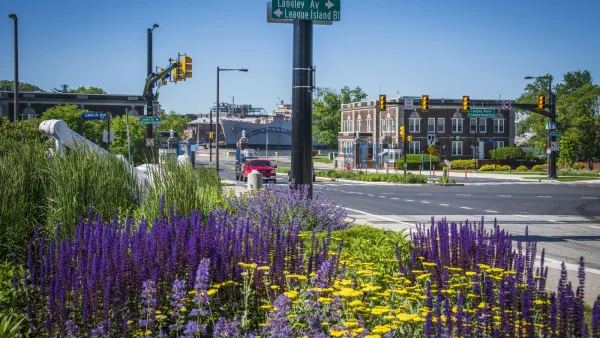
Philadelphia sees 29% drop in gun violence near new green spaces
A city-backed program that cleans up blighted and vacant lots is creating new public spaces and reducing crime in surrounding communities.
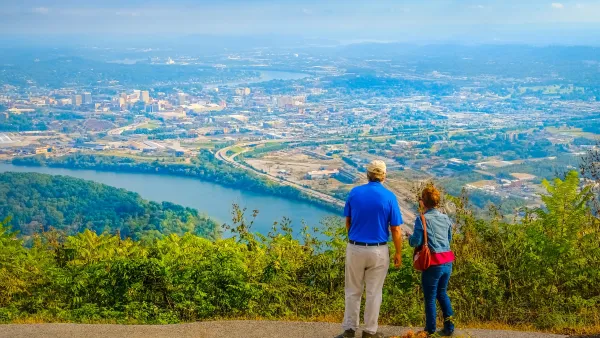
Chattanooga Earns North America’s First ‘National Park City’ Designation
The award recognizes cities that prioritize biodiversity and resident access to parks and green spaces.
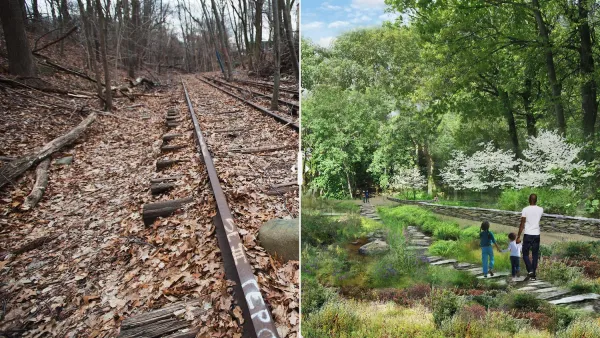
From Queens to Chattanooga, Federal Funding Cuts are Killing Park Projects
Cuts to grants from the Department of Transportation to the EPA are impacting small and large park projects across the country.

Planetizen Federal Action Tracker
A weekly monitor of how Trump’s orders and actions are impacting planners and planning in America.

The state-sanctioned urbicide of Austin
People don’t kill cities. Freeways do.

US to reduce Colorado River water deliveries to Mexico
A new Colorado Treaty amendment reduces Mexico’s Colorado River water allocation by 250,000 acre feet.

Mamdani overhauls NYC's Vision Zero plan with 100 new policy goals
The overhaul aims to reduce traffic deaths and make streets safer for pedestrians, cyclists and drivers through lower speed limits, new safety infrastructure and more.

Amtrak not solely to blame for New Jersey commuter rail's unreliability, report finds
A new study from the Garden State Initiative found that NJ Transit’s budget grew 20% across a 4 year period, but reliability declined significantly over the same period.

EPA erases limits on planet-warming pollution from power plants
Under Monday’s plan, power plants would still have some limits on how much mercury, arsenic and other contaminants they can emit.

FREE Course: Walkable City 1: Why Walkability?
After describing his path towards focusing on walkability as the essence of good planning, Jeff Speck marches through his five principal reasons for making more walkable places.
Reinventing Malls: Planning Alchemy—Turning Gray Fields Into Gold
The course focuses on the opportunities and imperatives that shape reinvention of mall sites.

Eagle County Government
Harvard University Graduate School of Design
Nashville Planning Department
The Architects Foundation
University of Cincinnati Online
The Pocatello Development Authority
The Urban Renewal Agency of the City of Pocatello
Journal of the American Planning Association