The Richmond-San Rafael Bridge will be the first in the Bay Area to eliminate toll booths entirely in favor of open-road tolling using sensors.


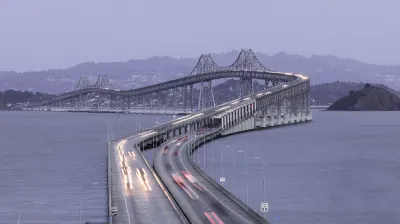
A Bay Area bridge is set to become the region’s first open-road tolling bridge as Cantrans prepares to remove obsolete toll booths from the Richmond-San Rafael Bridge this month, reports Adrian Rodriguez in The Mercury News.
“The project on the Richmond-San Rafael Bridge will be the first in a $318 million program to transition all seven state-owned bridges in the Bay Area to open-road tolling,” Rodriguez explains. The toll booths have not been in use since 2020, when the Metropolitan Transportation Commission-Bay Area Toll Authority switched to FasTrak tolling only.
The removal of the tollbooths is part of an effort to streamline traffic on the bridge during heavy commute times. “After removing the toll booths, crews will install a temporary tolling system that will read FasTrak transponders and license plates for charging tolls. Workers also will restripe the toll plaza pavement.” The bridge will later get an overhead structure with mounted toll readers.
FULL STORY: Richmond-San Rafael Bridge toll booths slated for removal

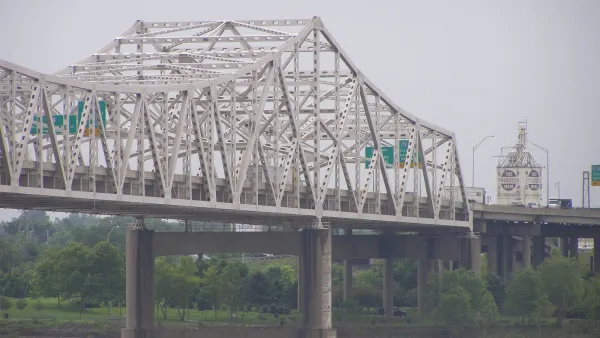
Evidence for Tolls as a 'Surefire' Traffic Congestion Fix
Traffic on a Louisville freeway fell by half after a toll was implemented. Could this be the best way to reduce traffic congestion?
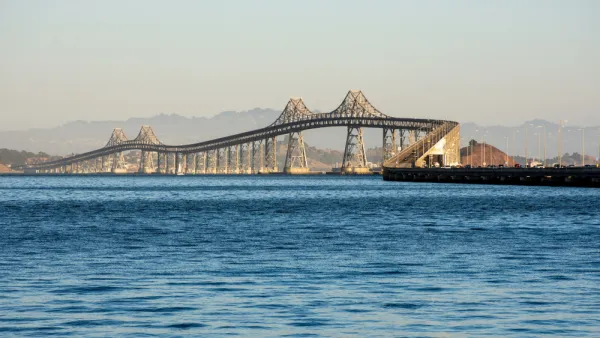
Crowdsourcing Ideas for Richmond-San Rafael Bridge Replacement
The Richmond-San Rafael Bridge, connecting the East Bay and the North Bay near San Francisco, is 63 years old, but a local elected official is thinking about how to replace it.
Gentrification and the Bay Area's Controversial Growth Management Plan
Is gentrification the inevitable result of land use planning that reduces greenhouse gas emissions by favoring infill development over auto-dependent sprawl? The Urban Displacement Project looks at the unintended effects of Plan Bay Area.

Planetizen Federal Action Tracker
A weekly monitor of how Trump’s orders and actions are impacting planners and planning in America.

The state-sanctioned urbicide of Austin
People don’t kill cities. Freeways do.

US to reduce Colorado River water deliveries to Mexico
A new Colorado Treaty amendment reduces Mexico’s Colorado River water allocation by 250,000 acre feet.

5 New England states march closer to 800 megawatt wind energy project
Securing federal approval for the project may be complicated under the Trump administration, which has historically been hostile towards domestic wind power.

Baltimore to break ground on $50 million Transit Priority Project
The project will bring faster bus trips, safer streets and better bike connections to Baltimore.

Airbnb launches $250 million 'last-dollar financing' housing accelerator, makes first investment in Austin
The company will put $6.4 million towards affordable housing development in Texas’ capital.

FREE Course: Walkable City 1: Why Walkability?
After describing his path towards focusing on walkability as the essence of good planning, Jeff Speck marches through his five principal reasons for making more walkable places.
Reinventing Malls: Planning Alchemy—Turning Gray Fields Into Gold
The course focuses on the opportunities and imperatives that shape reinvention of mall sites.

Eagle County Government
Harvard University Graduate School of Design
Nashville Planning Department
The Architects Foundation
University of Cincinnati Online
The Pocatello Development Authority
The Urban Renewal Agency of the City of Pocatello
Journal of the American Planning Association