Washington D.C. renters are losing housing aid and pandemic-era protections, leading to a wave of evictions.


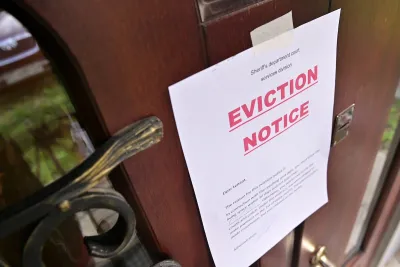
With housing assistance drying up and wages remaining stagnant, Washington, D.C. renters are being evicted at record rates, report James Jarvis and Taylor Nichols in The 51st.
“Last year, completed evictions in the District rose to record levels, with 1,869 households removed from their homes under a court order. That rise marked the largest increase since the year before the pandemic, according to new data from the Office of the Tenant Advocate obtained and analyzed by Street Sense, The 51st, and American University’s Investigative Reporting Workshop.” In the first half of 2025, 1,477 evictions had already been completed with three months left in the fiscal year.
Experts say the rise in eviction is the result of a combination of factors including reduced government assistance, a rollback in tenant protection laws, the end of the pandemic-era eviction moratorium, and rising housing costs. Evictions are also concentrated in majority-Black wards, and a Brookings Institution study found that “Black renters were nearly twice as likely to spend over 30% of their income on housing.”
According to the article, the city recently reduced emergency rent assistance and rolled back protections that required judges to pause eviction cases with open assistance applications. The recently passed RENTAL Act also shortens the notice landlords must give tenants, removes transparency requirements, and gives judges greater discretion over cases.
Read the full story: Affordable Housing Left Vulnerable After Trump Fires Building Inspectors

Two Weeks After Explosion, HUD Lays off Entire Building Inspection Staff
The move risks leaving subsidized housing with no oversight just weeks after a Bronx building partially collapsed.
Troubled Houston housing agency announces plan to resolve 'material deficiencies'
The newly renamed Housing Alliance Houston has created a new accounting team and instituted new tenant file inspections, per a recent update required by HUD.
NYC mayor announces plan to repair, restore and build new public housing
Roughly 300,000 New Yorkers live in the city's public housing system.

Planetizen Federal Action Tracker
A weekly monitor of how Trump’s orders and actions are impacting planners and planning in America.

California plans to bury El Niño’s downpour
If the state plays its cards right, it may be able to store a billion acre-feet of El Niño’s water in aquifers.

Desperate measures: Advocates weigh draining Lake Powell to fill Colorado River
Draining the reservoir could reduce evaporation losses by a couple hundred thousand acre-feet.

Chicago Avenue bridge construction delays enrages city leaders
The bridge has been closed since 2025. The city originally aimed to re-open it in December, and now expects to finish construction in 2027.

NYC bus network redesign speeds up Queens buses
Rush routes have seen a 4.6% speed increase after the redesign.

California High-Speed Rail Authority picks trainset manufacturer
The California High-Speed Rail Authority aims to start servicing passengers by 2033.

FREE Course: Walkable City 1: Why Walkability?
After describing his path towards focusing on walkability as the essence of good planning, Jeff Speck marches through his five principal reasons for making more walkable places.
Reinventing Malls: Planning Alchemy—Turning Gray Fields Into Gold
The course focuses on the opportunities and imperatives that shape reinvention of mall sites.

City of Rosemead
Rutgers University, Edward J. Bloustein School of Planning and Public Policy
One Hundred Miles
Hunter College, City University of New York (CUNY)
The Architects Foundation
University of Cincinnati Online
City of Cambridge
Montrose County
The Pocatello Development Authority