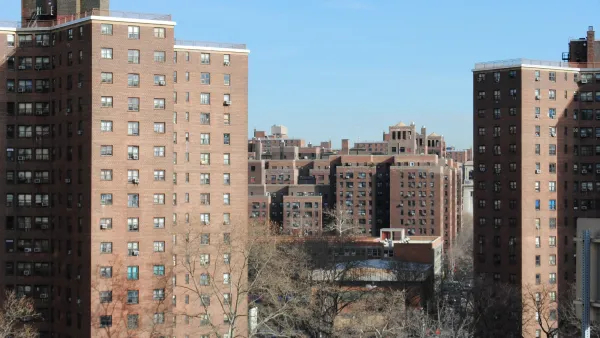
Roughly 300,000 New Yorkers live in the city's public housing system.


New York City Mayor Zohran Mamdani released a new plan aimed at improving the quality of the city's public housing and adding more units to the city's housing stock.
As Emma G. Fitzsimmons and Jeffery C. Mays explain in The New York Times, "The plan includes several measures to shore up public housing, including using two financing tools to raise money for repairs, restoring thousands of vacant apartments and building new housing on land owned by the authority."
The NYCHA faces a repair backlog of almost $80 billion. The mayor's plan uses two recent programs, Permanent Affordability Commitment Together (which works with private developers) and the Public Housing Preservation Trust (which the administration hopes will help renovate 25,000 existing apartments).
While Mamdani admitted that eliminating NYCHA's deficit requires help from the federal government, "Mr. Mamdani said that he wanted to prevent the capital deficit from growing during his tenure and that he wanted to make investments to improve people’s quality of life."
Read the full story: Mamdani’s Public Housing Plan Partly Relies on Private Sector

Report: Hundreds of Vacant NYC Public Housing Units ‘Taken Over’ by Squatters
The city’s housing authority says it often takes months to renovate apartments for new tenants, leading to hundreds of empty units that pose safety risks to neighbors.

New York Public Housing Needs $78 Billion in Repairs
A new assessment from the city’s housing agency calls for $60 billion in needed repairs over the next five years.

Troubled Houston housing agency announces plan to resolve 'material deficiencies'
The newly renamed Housing Alliance Houston has created a new accounting team and instituted new tenant file inspections, per a recent update required by HUD.

Planetizen Federal Action Tracker
A weekly monitor of how Trump’s orders and actions are impacting planners and planning in America.

California plans to bury El Niño’s downpour
If the state plays its cards right, it may be able to store a billion acre-feet of El Niño’s water in aquifers.

Chicago breaks ground on $3 billion megadevelopment
The new neighborhood, titled Foundry Park, will one day host 3,700 residences.

Satanic Place Names
From streams and lakes to valleys and canyons, I mapped more than 1,000 places named after the Devil.

California High-Speed Rail Authority CEO resigns after $600,000 scandal
Under Ian Choudri, the authority used taxpayer dollars to fund first class flights and trips to nightclubs.

Want to study the Missouri River? Soon, you may need unanimous approval from 10 states
Legislation would require 10 governors’ permission to study or build projects moving water outside the basin.

FREE Course: Walkable City 1: Why Walkability?
After describing his path towards focusing on walkability as the essence of good planning, Jeff Speck marches through his five principal reasons for making more walkable places.
Reinventing Malls: Planning Alchemy—Turning Gray Fields Into Gold
The course focuses on the opportunities and imperatives that shape reinvention of mall sites.

City of Rosemead
Rutgers University, Edward J. Bloustein School of Planning and Public Policy
One Hundred Miles
Hunter College, City University of New York (CUNY)
The Architects Foundation
University of Cincinnati Online
City of Cambridge
Montrose County
The Pocatello Development Authority