Newly proposed legislation aims to protect long-term tenants from displacement caused by Mayor Lurie’s proposed zoning reform plan, which would allow for more housing construction in parts of the city.



San Francisco supervisors are divided on Mayor Dan Lurie’s “family zoning” plan, which narrowly passed the city’s Planning Commission last week.
As Keith Menconi explains in the San Francisco Examiner, “Responding to fears that the upzoning push could result in widespread tenant displacement, Supervisors Myrna Melgar and Chyanne Chen introduced separate legislative packages this week intended to provide additional safeguards for renters and for San Francisco’s stock of rent-controlled apartments.”
According to Melgar, the plan, which is designed to create more housing in the famously unaffordable city, could harm existing tenants and businesses and push out long-term residents. “Chen’s legislation, introduced Tuesday, includes a variety tenant-protection measures intended to make sure that when apartment buildings are torn down to make way for new developments, low-income residents will be able to stay in those neighborhoods.”
Those measures include a requirement for landlords to notify tenants of redevelopment plans, financial assistance for displaced tenants, and the opportunity for tenants to return to redeveloped properties without a major rent hike.
Melgar’s legislation addresses rent-controlled apartments, which, once redeveloped, cannot be replaced due to a state law that blocks cities from enacting new rent control legislation. “Melgar’s proposed legislation would achieve that goal through a variety of methods, including a measure that aims to prevent the demolition of properties with unpermitted rental homes as well as another that introduces incentives for developers to voluntarily expand rent control.”
Mayor Lurie said he supports Melgar’s proposals, but did not endorse Chen’s proposed legislation. The city must pass a rezoning plan by January 1 to avoid incurring state penalties.
FULL STORY: SF lawmakers seek to sand off sharp edges of Lurie’s rezoning plan


Report Shows San Francisco’s ‘Family Zoning’ Plan Would Produce Less Than Half of Needed Housing Units
The city’s economic analysis reveals that a rezoning proposal would yield from 8,504 to 14,646 units, well below the number required by the state.
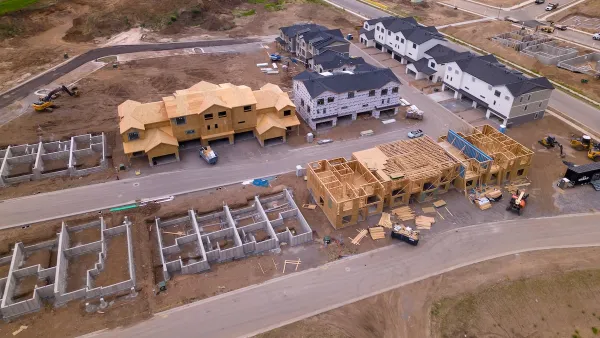
‘Montana Miracle:’ The State Actually Succeeding at Housing Reform
A series of ambitious zoning reforms is having a significant impact on the state’s housing supply.

NYC Council Approves Brooklyn Rezoning Plan
The Atlantic Avenue Mixed Use Plan includes infrastructure investments and could bring 4,600 new housing units to parts of Brooklyn.

The state-sanctioned urbicide of Austin
People don’t kill cities. Freeways do.

US to reduce Colorado River water deliveries to Mexico
A new Colorado Treaty amendment reduces Mexico’s Colorado River water allocation by 250,000 acre feet.

New Jersey’s second-largest city bans standalone data centers
Jersey City will continue to allow co-location facilities, such as those meant for research institutions that store their own data.

Amtrak not solely to blame for New Jersey commuter rail's unreliability, report finds
A new study from the Garden State Initiative found that NJ Transit’s budget grew 20% across a 4 year period, but reliability declined significantly over the same period.

EPA erases limits on planet-warming pollution from power plants
Under Monday’s plan, power plants would still have some limits on how much mercury, arsenic and other contaminants they can emit.

Phoenix announces new on-demand transit service, more frequent RAPID buses
Both new services will launch in October, and are part of Phoenix's Project Effective Access Solutions for Easing Congestion.

FREE Course: Walkable City 1: Why Walkability?
After describing his path towards focusing on walkability as the essence of good planning, Jeff Speck marches through his five principal reasons for making more walkable places.
Reinventing Malls: Planning Alchemy—Turning Gray Fields Into Gold
The course focuses on the opportunities and imperatives that shape reinvention of mall sites.

Eagle County Government
Harvard University Graduate School of Design
Nashville Planning Department
The Architects Foundation
University of Cincinnati Online
The Pocatello Development Authority
The Urban Renewal Agency of the City of Pocatello
Journal of the American Planning Association