A proposal supported by many city officials and road safety advocates would shift right-of-way enforcement to ‘Rapid Response Aides’ to free up police resources and clear blocked lanes more quickly.


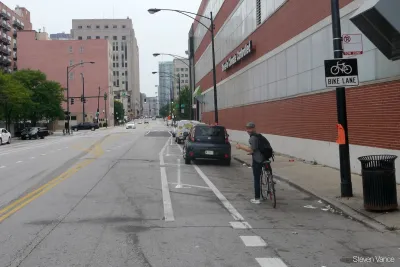
A Chicago pilot program would shift right-of-way enforcement duties from police to a ‘rapid response team’ that would be housed in the Department of Finance, reports John Greenfield in Streetsblog Chicago.
As Greenfield explains, “As it stands, Chicago's Office of Emergency Management and Communications sends all 911 calls about parking scofflaws to police dispatchers. Under a new pilot in these two CPD districts, the calls would instead go to Rapid Response Parking Enforcement Aides. They'd quickly be sent to the trouble spots to confirm the issue, and write a ticket if need-be.” In a Committee on Public Safety hearing, all the alderpersons and citizens who spoke favored the proposal, making it likely that it will be implemented.
According to Greenfield, the policy would be beneficial to cyclists and other sustainable transportation users by ensuring that blocked bike lanes, bus lanes, and crosswalks are cleared more quickly and efficiently. “Not only would the new policy give officers more time to focus on addressing violent crime, but it would also help create safer, more efficient conditions for all road users by helping to prevent obstructions caused by illegal parking.”

Chicago Approves New Parking Enforcement Pilot Programs
The city plans to test automated technology that will issue citations for blocking or parking in designated bike or bus lanes.
New Chicago Cameras Will Automatically Ticket Drivers Parked in Bus and Bike Lanes
The city is adding cameras to transit buses as part of a pilot program aimed at stopping drivers from blocking bus lanes.
Chicago Residents Sue City Over Inaccessible Sidewalks
The suit alleges the city has failed to create a “coordinated, proactive system” for complying with ADA and ensuring accessibility on the city’s sidewalks and crosswalks.

Planetizen Federal Action Tracker
A weekly monitor of how Trump’s orders and actions are impacting planners and planning in America.

The state-sanctioned urbicide of Austin
People don’t kill cities. Freeways do.

US to reduce Colorado River water deliveries to Mexico
A new Colorado Treaty amendment reduces Mexico’s Colorado River water allocation by 250,000 acre feet.

Mamdani overhauls NYC's Vision Zero plan with 100 new policy goals
The overhaul aims to reduce traffic deaths and make streets safer for pedestrians, cyclists and drivers through lower speed limits, new safety infrastructure and more.

Amtrak not solely to blame for New Jersey commuter rail's unreliability, report finds
A new study from the Garden State Initiative found that NJ Transit’s budget grew 20% across a 4 year period, but reliability declined significantly over the same period.

EPA erases limits on planet-warming pollution from power plants
Under Monday’s plan, power plants would still have some limits on how much mercury, arsenic and other contaminants they can emit.

FREE Course: Walkable City 1: Why Walkability?
After describing his path towards focusing on walkability as the essence of good planning, Jeff Speck marches through his five principal reasons for making more walkable places.
Reinventing Malls: Planning Alchemy—Turning Gray Fields Into Gold
The course focuses on the opportunities and imperatives that shape reinvention of mall sites.

Eagle County Government
Harvard University Graduate School of Design
Nashville Planning Department
The Architects Foundation
University of Cincinnati Online
The Pocatello Development Authority
The Urban Renewal Agency of the City of Pocatello
Journal of the American Planning Association