USDOT says it will take over management duties for the commercial spaces managed by Amtrak since last year and address the building’s infrastructure needs.


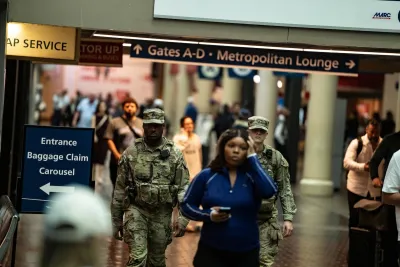
The U.S. Department of Transportation (DOT) announced it will reclaim management of Washington, D.C.’s Union Station, reports Rachel Treisman for NPR.
Although USDOT has owned the station since the 1980s, it has historically been managed by the Union Station Redevelopment Corporation, a local nonprofit founded in 1983. Amtrak took over operations last year.
Now, USDOT says “strong direction is needed to restore this federal asset to its former glory,” and D.C. Mayor Muriel Bowser noted that the station needs roughly $8 billion in repairs, which the District cannot afford. Bowser said shifting management is “step one,” but that “If it's about what Union Station needs for its total transformation, that would be an amazing initiative for the federal government to take on.” USDOT says it will “maximize the retail revenue of the station, the revenue of the station as an event space” to get the station on “stable financial footing” and “will address the building's infrastructure needs, which include improvements to its elevators, lighting and security, as well as ‘replacing the roof and other major systems.’”
Union Station serves about 70,000 passengers per day on over 200 daily trains, including Amtrak and regional commuter lines.
FULL STORY: The federal government is taking over D.C.'s Union Station. What does that mean?

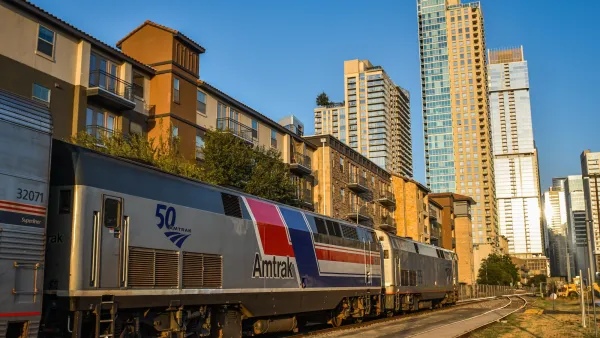
Texas DOT report outlines options for commuter rail between Austin and San Antonio
Amtrak currently operates just one trip per day between the two cities.
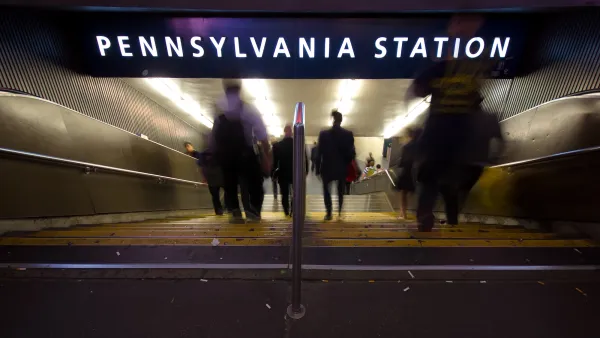
New Penn Station design won't move Madison Square Garden
Amtrak and federal officials agreed on a new plan for the station's redesign that may be largely funded by the federal government.
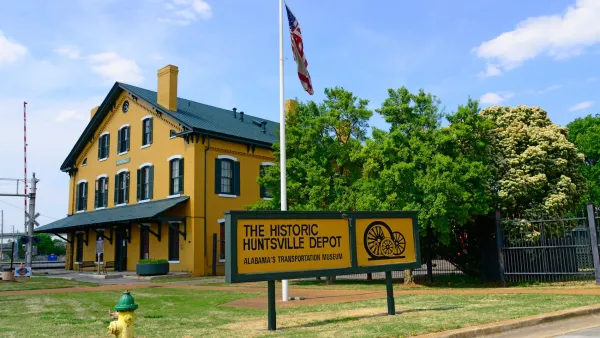
Huntsville wants to be a key Southern player in intercity rail
The Alabama city is commissioning a study to assess the potential for 'Amtrak-like' connections to Nashville, Atlanta, and other Southern cities.

Planetizen Federal Action Tracker
A weekly monitor of how Trump’s orders and actions are impacting planners and planning in America.

The state-sanctioned urbicide of Austin
People don’t kill cities. Freeways do.

US to reduce Colorado River water deliveries to Mexico
A new Colorado Treaty amendment reduces Mexico’s Colorado River water allocation by 250,000 acre feet.

Mamdani overhauls NYC's Vision Zero plan with 100 new policy goals
The overhaul aims to reduce traffic deaths and make streets safer for pedestrians, cyclists and drivers through lower speed limits, new safety infrastructure and more.

Amtrak not solely to blame for New Jersey commuter rail's unreliability, report finds
A new study from the Garden State Initiative found that NJ Transit’s budget grew 20% across a 4 year period, but reliability declined significantly over the same period.

EPA erases limits on planet-warming pollution from power plants
Under Monday’s plan, power plants would still have some limits on how much mercury, arsenic and other contaminants they can emit.

FREE Course: Walkable City 1: Why Walkability?
After describing his path towards focusing on walkability as the essence of good planning, Jeff Speck marches through his five principal reasons for making more walkable places.
Reinventing Malls: Planning Alchemy—Turning Gray Fields Into Gold
The course focuses on the opportunities and imperatives that shape reinvention of mall sites.

Eagle County Government
Harvard University Graduate School of Design
Nashville Planning Department
The Architects Foundation
University of Cincinnati Online
The Pocatello Development Authority
The Urban Renewal Agency of the City of Pocatello
Journal of the American Planning Association