The city will allow Waymo robotaxis and ride-hailing app vehicles to drive down the car-free stretch of Market Street as part of Mayor Dan Lurie’s effort to help revitalize local businesses.


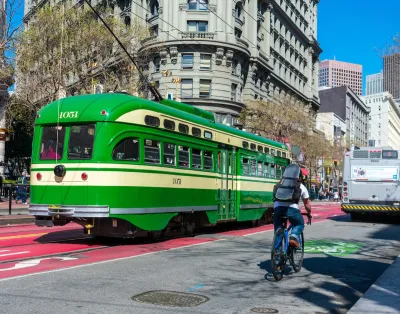
San Francisco banned cars on Market Street in 2020. Now, some cars, including autonomous Waymo taxis and Uber and Lyft black cars, are coming back, prompting concerns from transit and safety advocates that any new car traffic will slow buses.
As Rachel Swan explains in the San Francisco Chronicle, “The companies have agreed to a controlled ‘evaluation’ period, during which they will limit service to off-peak hours, and to designated pick-up and drop-off zones.”
The move is touted by Mayor Dan Lurie as an effort to revitalize the corridor by providing easier access to local businesses. “Though the mayor and other city officials define ride-hails as commercial carriers, and insist that these vehicles should have always been exempt from the ban, opponents of the move fear that adding cars of any kind will cause congestion and slow Muni. Transit and cycling advocates who crusaded for years to push cars off Market have accused the city’s new administration of undercutting their work.”
The mayor’s office predicts allowing ride-hailing in the area will have minimal impact, only adding roughly two vehicles per hour.
FULL STORY: Cars will soon return to section of San Francisco’s Market Street

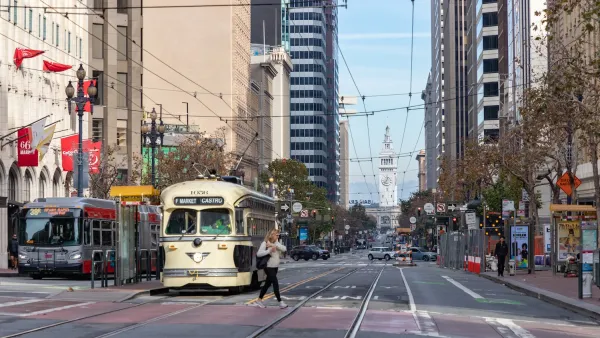
Waymo Gets Permission to Map SF’s Market Street
If allowed to operate on the traffic-restricted street, Waymo’s autonomous taxis would have a leg up over ride-hailing competitors — and counter the city’s efforts to grow bike and pedestrian on the thoroughfare.
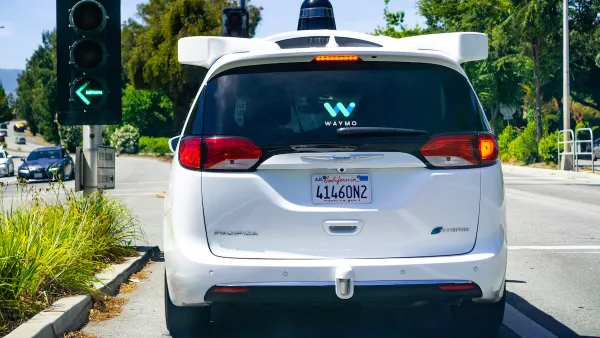
Advice for Autonomous Cars
Drivers for Uber and Lyft in San Francisco express their concerns and advice for self-driving taxi services.
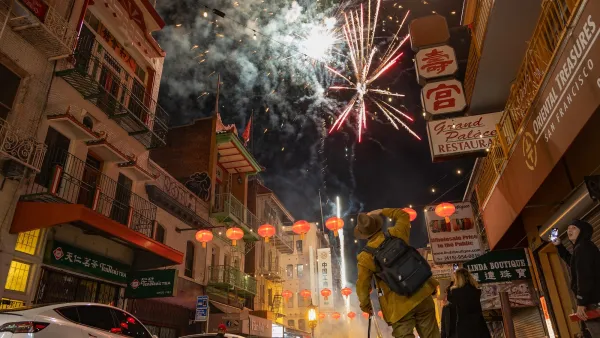
4th of July fireworks cause mass chaos for Waymos in San Francisco
Dozens of robotaxis stalled, and one drove over live fireworks, during the July 4th holiday.

Planetizen Federal Action Tracker
A weekly monitor of how Trump’s orders and actions are impacting planners and planning in America.

The state-sanctioned urbicide of Austin
People don’t kill cities. Freeways do.

US to reduce Colorado River water deliveries to Mexico
A new Colorado Treaty amendment reduces Mexico’s Colorado River water allocation by 250,000 acre feet.

5 New England states march closer to 800 megawatt wind energy project
Securing federal approval for the project may be complicated under the Trump administration, which has historically been hostile towards domestic wind power.

Baltimore to break ground on $50 million Transit Priority Project
The project will bring faster bus trips, safer streets and better bike connections to Baltimore.

Airbnb launches $250 million 'last-dollar financing' housing accelerator, makes first investment in Austin
The company will put $6.4 million towards affordable housing development in Texas’ capital.

FREE Course: Walkable City 1: Why Walkability?
After describing his path towards focusing on walkability as the essence of good planning, Jeff Speck marches through his five principal reasons for making more walkable places.
Reinventing Malls: Planning Alchemy—Turning Gray Fields Into Gold
The course focuses on the opportunities and imperatives that shape reinvention of mall sites.

Eagle County Government
Harvard University Graduate School of Design
Nashville Planning Department
The Architects Foundation
University of Cincinnati Online
The Pocatello Development Authority
The Urban Renewal Agency of the City of Pocatello
Journal of the American Planning Association