New York City is the latest in a string of global cities to launch successful congestion pricing schemes.


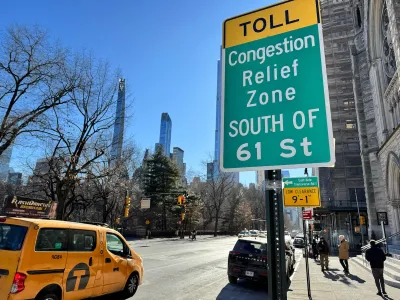
In the wake of New York City’s long-awaited adoption of its congestion pricing program, Dan Zukowski highlights four other global cities that have implemented road pricing.
The first city to establish a congestion pricing scheme was Singapore back in 1975, when a tax for entering the city led to a 20 percent drop in traffic in months. The city later upgraded to an automated system that dynamically adjusts tolls based on location, time of day, vehicle type, and travel speed.
London launched its congestion pricing scheme in 2003, and quickly saw opposition drop as Londoners experienced the benefits of reduced traffic and faster buses. Three years later, Stockholm launched its own program, using the revenue to expand its transit system. And “Milan started charging vehicles based on their emissions in 2008, then replaced that program in 2012 with a congestion charge on weekdays at certain hours. Within two years, traffic in the zone known as Area C decreased by 28%. Traffic collisions involving injuries declined over 26%, and CO2 emissions were down 35%.”
The success of New York City’s program, which led to significant reductions in traffic and improved bus travel times, could encourage more U.S. cities to try it.
Read the full story: 5 cities with congestion pricing
NYC Congestion Pricing Continues to Show Positive Results
While the Trump administration attempts to revoke the program’s federal approval, congestion pricing continues to reduce traffic, speed up bus travel times, and improve air quality in Manhattan.

NYC Congestion Pricing Goes Into Effect
The long-awaited congestion pricing program began on January 5.
Congestion Pricing Compromise?
A CBS News New York report suggests that Gov. Kathy Hochul is considering lifting her ‘indefinite pause’ on the Manhattan congestion pricing project if the $15 toll was lowered. Litigation threatened by the NYC comptroller may be a factor.

Planetizen Federal Action Tracker
A weekly monitor of how Trump’s orders and actions are impacting planners and planning in America.

California plans to bury El Niño’s downpour
If the state plays its cards right, it may be able to store a billion acre-feet of El Niño’s water in aquifers.

Desperate measures: Advocates weigh draining Lake Powell to fill Colorado River
Draining the reservoir could reduce evaporation losses by a couple hundred thousand acre-feet.

In Texas, data centers are swallowing promised parkland
Residents who moved to Taylor, Texas for a rural community now have to contend with three data centers in their backyard.

How a Chicago-sized wind farm beat the odds and powered on
The project spanned five presidential administrations and a standoff with a U.S. military base.

MTA gives itself 30 days to transform pit into basketball court
The site has been under construction since 2022; the city originally estimated it would finish the court in 2024.

FREE Course: Walkable City 1: Why Walkability?
After describing his path towards focusing on walkability as the essence of good planning, Jeff Speck marches through his five principal reasons for making more walkable places.
Reinventing Malls: Planning Alchemy—Turning Gray Fields Into Gold
The course focuses on the opportunities and imperatives that shape reinvention of mall sites.

City of Rosemead
Rutgers University, Edward J. Bloustein School of Planning and Public Policy
One Hundred Miles
Hunter College, City University of New York (CUNY)
The Architects Foundation
University of Cincinnati Online
City of Cambridge
Montrose County
The Pocatello Development Authority