Decades ago, we started building a society based around car ownership, making it difficult to navigate U.S. cities without one. Are we making the same mistakes with smartphones?


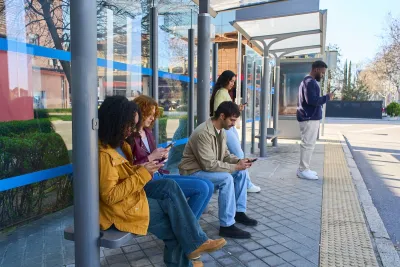
By now, most planners are aware of the negative impacts of car-centric development and the failures of building a system that makes people dependent on one specific technology: the automobile. But are we now making the same mistakes, building society around one device: the smartphone?
This is what Owen Haacke posits in an opinion piece for Next City. Haacke notes that much of modern life is becoming entwined with smartphone ownership. “Restaurants place QR codes on the table to order; paper menus are absent. Parking meters require an app for payment; coins are no longer an option. Events require e-tickets linked to a phone’s Near Field Communication (NFC) chip, the “tap to pay” technology, without an option to attend the event without one.” And while these changes may offer convenience for some, they can exclude others.
“More concerning, smartphone dependence is creeping into essential services we need to function in society. Public transit only offers routes and schedules on apps. Workplaces require authentication apps to clock in. Clinics require apps to check in.” Without preserving analog options, people are forced to adapt — or be left out.
Instead of letting smartphones overtake society the way cars did, Haacke suggests that “We can avoid that fate if we act with collective will.” Accessing services without a smartphone should be a basic right — and could help reduce the anxiety and dependency that comes with constant smartphone use. “If our infrastructure assumes everyone carries a smartphone to function, then all efforts to reduce screen time are futile.”
Read the full story: Our Smartphone-Dependent Culture Is Repeating the Mistakes of Car-Centric Infrastructure

The Parking Lot Maternity Leave
New parenthood is the stress test of suburbia. I’ve learned the hard way just how spectacularly it fails.
How Car-Oriented Infrastructure Harms Public Health
A new documentary shows the ways that infrastructure designed for cars and not people is making us ill.

Study: D.C. Region Must Take Aggressive Steps To Reach Climate Goal
To achieve its stated emissions reduction goal, the Greater Washington area must sharply reduce driving and speed up the adoption of electric vehicles.

Planetizen Federal Action Tracker
A weekly monitor of how Trump’s orders and actions are impacting planners and planning in America.

The state-sanctioned urbicide of Austin
People don’t kill cities. Freeways do.

US to reduce Colorado River water deliveries to Mexico
A new Colorado Treaty amendment reduces Mexico’s Colorado River water allocation by 250,000 acre feet.

Nation's most wind-powered state turns to coal as data centers increase energy demand
For the first time in decades, Iowa has increased its generation of coal power.

NYC cools commuters with city's first rain garden above a bus stop
New York City officials say the plants in the rain garden can absorb 16 gallons of rainwater during heavy storms.

Brightline West’s future may rely on $6 billion federal loan
The company has until Nov. 2 to make a $400 million equity investment into its proposed high-speed rail line.

FREE Course: Walkable City 1: Why Walkability?
After describing his path towards focusing on walkability as the essence of good planning, Jeff Speck marches through his five principal reasons for making more walkable places.
Reinventing Malls: Planning Alchemy—Turning Gray Fields Into Gold
The course focuses on the opportunities and imperatives that shape reinvention of mall sites.

Greater Baltimore Committee
Eagle County Government
Harvard University Graduate School of Design
The Architects Foundation
University of Cincinnati Online
The Pocatello Development Authority
The Urban Renewal Agency of the City of Pocatello
Journal of the American Planning Association