The University of Alabama at Birmingham is using GIS technology, student engagement, and sustainability-driven planning to manage and protect its nationally recognized urban forest.



The University of Alabama at Birmingham (UAB) has become a national model for urban forestry, earning Tree Campus USA honors for 11 consecutive years and the Tree Campus Healthcare designation for the past six. These recognitions from the National Arbor Day Foundation reflect UAB’s commitment to planting and preserving more than 4,400 trees across its urban campus while actively engaging students and staff in environmental stewardship. In 2022, students from an interdisciplinary public health course helped update the university’s tree inventory, cataloging nearly 70 percent of its diverse tree population.
In 2024, UAB adopted Geographic Information System (GIS) technology to enhance its tree management practices. As Shannon Thomason reports, the GIS platform — spearheaded by UAB’s Senior Arborist Scott Thompson — tracks species, age, size, health, treatments, and even photos of each tree. With over 2,500 trees now documented, the system allows UAB to monitor tree health over time and assess the environmental and economic benefits of its campus canopy. The university has also begun identifying and mapping notable trees, such as heritage and memorial trees, to preserve their cultural significance.
UAB’s efforts are guided by its broader sustainability goals, which balance the demands of ongoing campus development with environmental responsibility. When trees must be removed for construction, they are either replaced with similar plantings or valued and compensated through the Tree Replacement Fund. In a region where shade is vital, UAB’s trees help reduce temperatures, improve air quality, and control erosion. Through the integration of advanced technology, educational engagement, and long-term planning, UAB is setting an example for how universities can become greener while growing smarter.
Read the full story: How UAB protects and preserves its nationally recognized urban forest

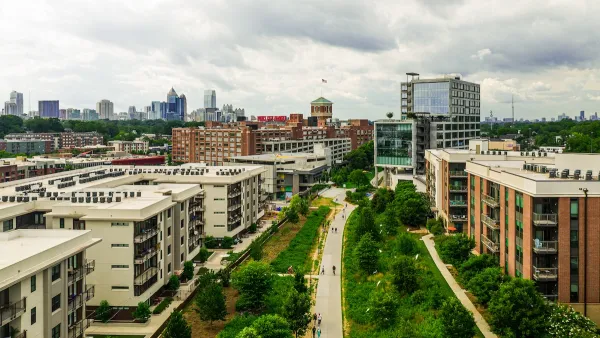
Mapping Georgia’s Urban Forests
Georgia Tech’s latest urban canopy assessment for Atlanta uses high-resolution mapping and a Potential Planting Index to guide data-driven tree preservation.

LA County Releases Draft Community Forest Management Plan
LA County's Chief Sustainability Office just released the discussion draft of Room to Grow, the first Community Forest Management Plan for the county.

The Problem with Tree Planting Programs
Ambitious campaigns to plant trees in urban areas often don't take into account the complexities of growing and maintaining effective urban forests.

Planetizen Federal Action Tracker
A weekly monitor of how Trump’s orders and actions are impacting planners and planning in America.

‘Going backwards:’ Baltimore mayor, students rally against state's transit funding plan
Maryland's proposed six-year plan provides no funding for Baltimore’s BMORE bus program and reduces its road maintenance funding.

Detroit to transform waterfront with $2.2 billion investment
Developers will convert about 18 acres of unused parking lot space into civic spaces.

HUD, USDA agree on framework to simplify housing environmental review standards
Their agreement is a requirement of the 21st Century ROAD to Housing Act.

Cost of water rising at a faster pace than inflation, median household income
California and Maryland residents have seen their water bills grow especially high.

NYC building owners overwhelmingly comply with new emissions limits
The New York City Department of Buildings is fining owners who did not file emissions reports.

FREE Course: Walkable City 1: Why Walkability?
After describing his path towards focusing on walkability as the essence of good planning, Jeff Speck marches through his five principal reasons for making more walkable places.
Reinventing Malls: Planning Alchemy—Turning Gray Fields Into Gold
The course focuses on the opportunities and imperatives that shape reinvention of mall sites.

planning NEXT
City of Thousand Oaks
City of Wisconsin Rapids
The Architects Foundation
University of Cincinnati Online
Northern Illinois Transit Authority (NITA)
The Pocatello Development Authority
The Urban Renewal Agency of the City of Pocatello