Washington’s statewide cap on annual residential rent increases will be just shy of 10 percent next year, down slightly from its current level.


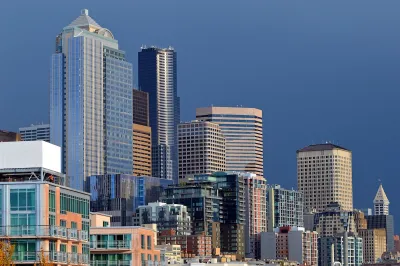
This story by Jake Goldstein-Street was originally published in Washington State Standard.
The limit, which takes effect Jan. 1, will be set at 9.683 percent, the state’s Department of Commerce said Friday.
House Bill 1217, signed into law in May by Gov. Bob Ferguson, restricts annual residential rent increases to 7 percent plus inflation, or 10 percent whichever is lower.
The law went into effect immediately, with the rate for the rest of 2025 set at the 10% maximum, as 7 percent plus inflation equaled 10.8 percent.
Going forward, the Department of Commerce will announce the annual rent limit each July. The timing is based on the release of inflation data from the U.S. Bureau of Labor Statistics.
Rent hikes of any degree aren’t allowed in the first year of a tenancy under Washington’s landmark law. But landlords can set rent however they please when the tenant moves in.
The cap doesn’t apply to all homes. For example, new construction is not covered for its first 12 years. Public housing authorities, low-income developments, and duplexes, triplexes and fourplexes in which the owner lives in one of the units are also exempt.
For manufactured homes, increases are capped at 5 percent.
If a landlord raises rent above the caps without an exemption, the renter must give the landlord a chance to fix the error or can terminate their lease with 20 days’ notice. A tenant or the state attorney general can bring litigation to enforce compliance. The attorney general can recover up to $7,500 per violation.
The legislation was one of the most divisive this session in Olympia. Progressives had initially pushed for a hard 7 percent limit, but ran into opposition from moderate Democrats.
Democrats hope the compromise provides a modicum of predictability to renters. Republicans fear it’ll chill development and price out small landlords who won’t be able to keep up with maintenance costs without the flexibility to raise rents as they wish.
Under the law, the limit on rent increases will remain in effect until 2040.
Read the full story: WA’s new rent cap set just below 10% for 2026


Landlords Fined for First Time Under WA’s New Law Capping Rent Increases
For the first time, Washington’s attorney general has enforced the state’s new cap on rent hikes, fining eight landlords $2,000 each for violating the law.
Washington Legislature Passes Rent Increase Cap
A bill that caps rent increases at 7 percent plus inflation is headed to the governor’s desk.
32 years after it was banned, could Massachusetts get rent control back?
In Massachusetts, the collection of more than 124,000 signatures makes it likely that a statewide rent control measure will be on the ballot in November.

Planetizen Federal Action Tracker
A weekly monitor of how Trump’s orders and actions are impacting planners and planning in America.

California plans to bury El Niño’s downpour
If the state plays its cards right, it may be able to store a billion acre-feet of El Niño’s water in aquifers.

Chicago breaks ground on $3 billion megadevelopment
The new neighborhood, titled Foundry Park, will one day host 3,700 residences.

Satanic place names
From streams and lakes to valleys and canyons, I mapped more than 1,000 places named after the Devil.

California High-Speed Rail Authority CEO resigns after $600,000 scandal
Under Ian Choudri, the authority used taxpayer dollars to fund first class flights and trips to nightclubs.

Want to study the Missouri River? Soon, you may need unanimous approval from 10 states
Legislation would require 10 governors’ permission to study or build projects moving water outside the basin.

FREE Course: Walkable City 1: Why Walkability?
After describing his path towards focusing on walkability as the essence of good planning, Jeff Speck marches through his five principal reasons for making more walkable places.
Reinventing Malls: Planning Alchemy—Turning Gray Fields Into Gold
The course focuses on the opportunities and imperatives that shape reinvention of mall sites.

City of Rosemead
Rutgers University, Edward J. Bloustein School of Planning and Public Policy
One Hundred Miles
Hunter College, City University of New York (CUNY)
The Architects Foundation
University of Cincinnati Online
City of Cambridge
Montrose County
The Pocatello Development Authority