Local energy “islands” within the larger power system ensure key facilities can remain online during emergencies and power outages.



This article by Alex Brown was originally published in Oregon Capital Chronicle.
Oregon lawmakers have passed a pair of bills to enable “microgrids” within the larger power system.
Microgrids are essentially local “islands” of energy generation and storage systems that connect to a utility but can operate independently when needed. Many are designed to serve community facilities such as hospitals and schools during emergencies.
California passed its own microgrid policy in 2018, but Oregon advocates say the new legislation there is the most ambitious in the nation.
If a utility needs to shut off transmission lines during a period of high wildfire danger, a community microgrid could use a combination of local solar and battery storage to keep key facilities online even while cut off from the main grid.
The pair of bills in Oregon passed with large, bipartisan majorities and are awaiting the expected signature of Democratic Gov. Tina Kotek.
One of the bills orders the Oregon Public Utility Commission to create a regulatory framework for private and community-owned microgrids. It also orders regulators to establish rules for buildings to connect to microgrids. Under the measure, local governments can establish “microgrid zones” with unique land-use regulations.
Oregon state Rep. Mark Gamba, a Democrat who serves as vice chair of the House Climate, Energy, and Environment Committee, said the state needs further changes to its land use to speed up permitting for energy projects. The microgrid legislation, he said, “cuts a little bit of red tape.”
“This is not the end-all, be-all on fixing the permitting system by any stretch, but this was what we could get passed this year,” Gamba said in an interview.
The other bill would allow a public utility or a third-party consultant to evaluate requests to connect a microgrid to the public power grid. Backers say it would help ease a regulatory bottleneck slowing clean energy projects, trade publication Utility Dive reported.
Rural communities are especially susceptible to power reliability issues, Dylan Kruse, president of Oregon-based nonprofit Sustainable Northwest, told Utility Dive.
Some utilities opposed the legislation, Oregon Public Broadcasting reported, saying it could be risky to allow third parties to connect to utility infrastructure. They cited their own work to establish microgrids with public partners.
Kruse told OPB that wildfires, heat waves and snowstorms are creating urgency to make the grid more resilient.
“We’re seeing challenges with the grid,” he said. “It’s impacting communities and we’re seeing a lot more of these outages and they are looking for alternatives to say, ‘Look, if the lights are going to go off, we’ve got to have some options here’.”
Read the full story: Oregon approves ambitious framework for ’microgrids’

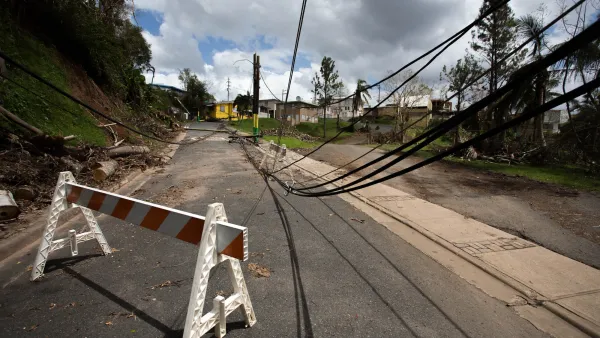
Bad Bunny's Iconic Electrical Pole Moment Highlights Puerto Rico’s Devastating Power Outages
The Reggaeton star’s halftime show included countless nods to his homeland, including a reference to the island’s ongoing power crisis.

Building a Just Energy Transition
A new book outlines a “four-plus pillars” framework for phasing out fossil fuels while addressing systemic inequities, emphasizing public support, dedicated funding, economic diversification, coalitions, and reforms that dismantle extractive systems.

Data Centers Threaten Western Water Supplies, Power Grids
The rapidly growing need for water to cool data centers is endangering one of the West’s most essential resources.

‘Going backwards:’ Baltimore mayor, students rally against state's transit funding plan
Maryland's proposed six-year plan provides no funding for Baltimore’s BMORE bus program and reduces its road maintenance funding.

Detroit to transform waterfront with $2.2 billion investment
Developers will convert about 18 acres of unused parking lot space into civic spaces.

Mamdani sent nearly 6,000 pied-à-terre tax warnings to homes that didn’t qualify
A judge has ordered the administration to cancel thousands of pied-à-terre tax notices after it sent 35% of them erroneously.

25 states, cities sue the EPA over erased power plant emissions limits
The coalition also intends to sue the EPA for not regulating emissions from gas-fired power plants.

Newsom vetoes giving CA tribes greater voice in water projects
In his veto letter, Newsom said the bill would add ‘uncertainty’ to the state’s fight to secure Californians’ water supplies.

Michigan Senate votes to revise 'lax' dam safety laws
A Bridge Michigan investigation found more than 100,000 Michigan residents live in the floodpath of a high or significant-hazard dam.

FREE Course: Walkable City 1: Why Walkability?
After describing his path towards focusing on walkability as the essence of good planning, Jeff Speck marches through his five principal reasons for making more walkable places.
Reinventing Malls: Planning Alchemy—Turning Gray Fields Into Gold
The course focuses on the opportunities and imperatives that shape reinvention of mall sites.

City of Thousand Oaks
City of Wisconsin Rapids
Harvard University Graduate School of Design
The Architects Foundation
University of Cincinnati Online
Northern Illinois Transit Authority (NITA)
The Pocatello Development Authority
The Urban Renewal Agency of the City of Pocatello