With less federal funding available for disaster relief efforts, the need to relocate at-risk communities is more urgent than ever.


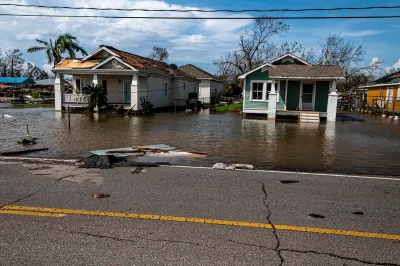
As federal agencies like FEMA, which the President has expressed a desire to dismantle, pull back on disaster assistance and other federal funding, the need for managed retreat from areas at high risk of flooding is becoming more urgent.
As Ella Hanson explains in an opinion piece in Governing, “States and localities will never be able to fill the void left by the federal government. But as governors, mayors and county leaders make difficult decisions about how to allocate their limited resources, there is an underutilized strategy that can significantly reduce the cost of future disasters: relocating residents from floodplains through voluntary buyouts.”
According to Hudson, managed retreat, not a common tactic in the United States, could “prevent the most devastating consequences of the disasters that inevitably lie ahead.” Until now, the federal government funded buyouts after disasters which have been “extremely effective” but “slow to deploy and limited in scale.”
Pointing to examples from New Jersey, North Carolina, and Texas, Hudson notes that states and cities can act faster than federal agencies to process buyouts and help residents relocate. Because convincing people to relocate requires a lot of information and trust, “Permanent buyout programs with full-time case managers are uniquely positioned to form relationships with homeowners, raise awareness about flood risk and help communities reimagine the use of newly acquired public land.”
FULL STORY: The Case for Paying Americans to Move Out of Floodplains

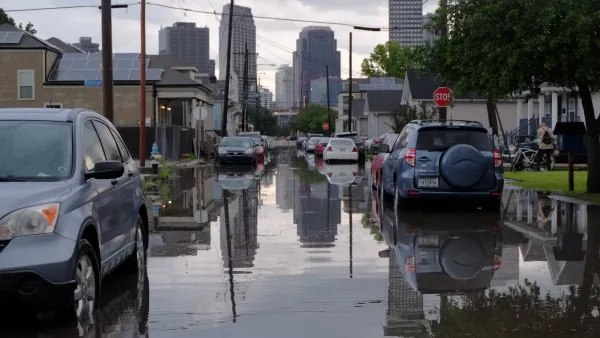
Study: New Orleans sea level rise is at 'point of no return'
Research shows that the city could be surrounded by water by the end of this century.
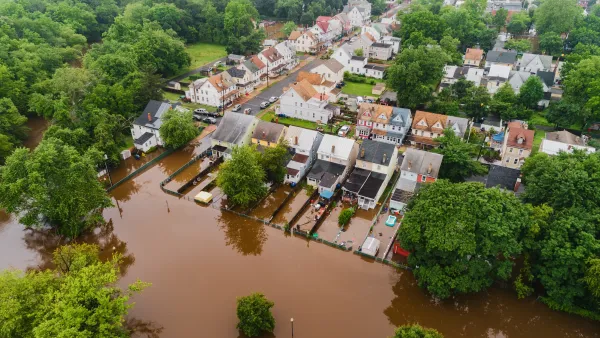
New Jersey Buyout Program Turns Flood-Prone Properties Into Green Buffer Zones
For 30 years, The Blue Acres program has offered homeowners in high-risk flood zones the chance to relocate, preserving land as open space.
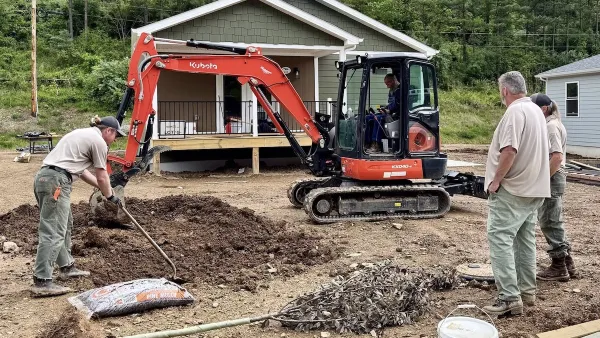
Kentucky Nonprofits Build ‘Higher Ground’ Homes
After destructive floods displaced thousands of Kentucky families, developers are building climate-resilient homes away from flood-prone areas.

Planetizen Federal Action Tracker
A weekly monitor of how Trump’s orders and actions are impacting planners and planning in America.

The state-sanctioned urbicide of Austin
People don’t kill cities. Freeways do.

US to reduce Colorado River water deliveries to Mexico
A new Colorado Treaty amendment reduces Mexico’s Colorado River water allocation by 250,000 acre feet.

5 New England states march closer to 800 megawatt wind energy project
Securing federal approval for the project may be complicated under the Trump administration, which has historically been hostile towards domestic wind power.

Baltimore to break ground on $50 million Transit Priority Project
The project will bring faster bus trips, safer streets and better bike connections to Baltimore.

Airbnb launches $250 million 'last-dollar financing' housing accelerator, makes first investment in Austin
The company will put $6.4 million towards affordable housing development in Texas’ capital.

FREE Course: Walkable City 1: Why Walkability?
After describing his path towards focusing on walkability as the essence of good planning, Jeff Speck marches through his five principal reasons for making more walkable places.
Reinventing Malls: Planning Alchemy—Turning Gray Fields Into Gold
The course focuses on the opportunities and imperatives that shape reinvention of mall sites.

Eagle County Government
Harvard University Graduate School of Design
Nashville Planning Department
The Architects Foundation
University of Cincinnati Online
The Pocatello Development Authority
The Urban Renewal Agency of the City of Pocatello
Journal of the American Planning Association