Without reform, restrictive zoning codes will limit the impact of the city’s planned transit expansion and could exclude some of the residents who depend on transit the most.


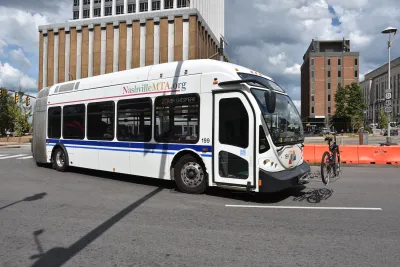
A report from the Urban Institute finds a mismatch between Nashville’s current zoning codes and the city’s “ambitious $3.1 billion transit investment plan,” dubbed “Choose How You Move.”
Rthvika Suvarna describes the report’s findings in Bloomberg CityLab, noting that the report shows only about 26 percent of Nashville’s housing units are within a half mile of the planned transit corridors. “These transit-adjacent areas are already experiencing pronounced gentrification, raising red flags about equitable access to improved bus service.” Meanwhile, zoning codes prohibit multifamily housing in many of these areas (and 90 percent of the city’s residentially zoned land). “The research also highlights a mismatch: Available multifamily development capacity is overwhelmingly concentrated in neighborhoods with the lowest property values, precisely where market-driven investment is least likely to materialize.”
According to Suvarna, “The city’s planning department projects a need for some 80,000 new housing units by 2040, but under current policies, only about 50,000 are likely to be built.” The report recommends more comprehensive zoning reforms to allow multifamily housing in more areas and “ensure that those who would benefit most from public transportation don’t find themselves increasingly isolated in transit-poor areas.”
Read the full story: Nashville’s $3 Billion Transit Plan Brings a Call for Zoning Reform

Opinion: California’s SB 79 Would Improve Housing Affordability and Transit Access
A proposed bill would legalize transit-oriented development statewide.
San Diego wants to limit upzoning law to just 16% of transit-adjacent parcels
The city's planning director says some areas are unfit for immediate upzoning due to a lack of resources or hazards such as wildfire risk.

LA Metro Opposes TOD Law, Fearing Backlash to Transit Expansion
Metro wants an exemption from California’s new housing law, despite the law’s potential to increase ridership by putting more housing near transit stations.

Planetizen Federal Action Tracker
A weekly monitor of how Trump’s orders and actions are impacting planners and planning in America.

The state-sanctioned urbicide of Austin
People don’t kill cities. Freeways do.

US to reduce Colorado River water deliveries to Mexico
A new Colorado Treaty amendment reduces Mexico’s Colorado River water allocation by 250,000 acre feet.

Nation's most wind-powered state turns to coal as data centers increase energy demand
For the first time in decades, Iowa has increased its generation of coal power.

NYC cools commuters with city's first rain garden above a bus stop
New York City officials say the plants in the rain garden can absorb 16 gallons of rainwater during heavy storms.

Brightline West’s future may rely on $6 billion federal loan
The company has until Nov. 2 to make a $400 million equity investment into its proposed high-speed rail line.

FREE Course: Walkable City 1: Why Walkability?
After describing his path towards focusing on walkability as the essence of good planning, Jeff Speck marches through his five principal reasons for making more walkable places.
Reinventing Malls: Planning Alchemy—Turning Gray Fields Into Gold
The course focuses on the opportunities and imperatives that shape reinvention of mall sites.

.jpg)
Greater Baltimore Committee
Eagle County Government
Harvard University Graduate School of Design
The Architects Foundation
University of Cincinnati Online
The Pocatello Development Authority
The Urban Renewal Agency of the City of Pocatello
Journal of the American Planning Association