A review of The Sustainable Urban Design Handbook, by architects Nico Larco and Kaarin Knudson.


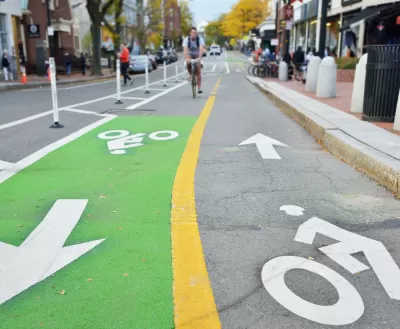
More than one book has sought to create lists of pro-walkability and pro-smart growth policies. But in The Sustainable Urban Design Handbook, Nico Larco and Kaarin Knudson seek to combine this idea with sustainability (or, in plain English, environmental protection) by listing dozens of urban planning policies that both improve the physical environment and make cities more walkable and/or transit-friendly. For example the book has chapters not only on issues traditionally associated with the smart growth movement (such as zoning, transit and street design), but also on traditional environmental issues such as stormwater runoff and wildlife preservation.
This book has a few other unique features:
- Rather than merely listing policies, the authors describe the cost and difficulty of each option. For example, in a section on “Multimodal Street Design” the authors describe pedestrian-oriented design as “[l]ow-medium cost and low difficulty” in undeveloped areas, but “[h]igh cost and high difficulty” in already built-out areas. They explain that in the latter type of place, retrofitting wider streets might require “traffic engineering and changes in intersection design.”
- In each chapter, the authors describe a “typical approach” and then critique that approach. For example, in the “multimodal street” section they point out that American streets are typically “designed almost exclusively to the needs of automobiles.” They add that this policy is inequitable because of its negative impact upon nondrivers, and propose that streets “should be narrow to control traffic speeds."
- The authors are willing to discuss tradeoffs. For example, in a chapter on public transit, they write that transit agencies have a choice between ridership and coverage goals. Some cities might choose to “provide everyone with some level of transit service, which is critically important for those with no other options.” On the other hand, a transit agency seeking to maximize ridership will place “frequent service along dense, high-population corridors.” A city that follows this policy can afford to “serve more people with more frequent service and lower operating costs per rider.” Similarly, if government protects habitat by limiting development in urbanized areas, it risks “push[ing] development to the periphery of urban areas… This can increase travel distances, promote car use, and increase stormwater runoff.” The authors recommend that zoning should keep vulnerable populations away from polluting land uses such as transportation corridors and heavy industry, but add that such polluting land uses “can contribute significantly to local economies and employment.”
- The authors are sensitive to regional differences. Rather than consistently endorsing or attacking tall buildings, they suggest that taller buildings are especially beneficial in hot areas. They explain that cities often suffer from an “urban heat island effect” as buildings trap heat, but that taller buildings mitigate this effect in hot climates, because “taller, narrower streets shade the public realm and minimize the reflected heat trapped within urban areas.” On the other hand, cold climates might require “bulkier buildings that minimize the amount of exposed building envelope” which in turn might “limit the amount of daylight that reaches building interiors… [which] increases the need for energy to power electric lighting.”
- The authors explain the relationship between status quo policies and their negative environmental impacts. For example, municipal laws requiring landowners to create large parking lots for shops and offices create large amounts of impervious surface that in turn increase stormwater runoff.
One part of this book may be outdated. The authors argue that development should be pushed away from flood-prone areas into “areas with low flood frequency.” But flooding is no longer limited to coastal areas. For example, in 2021 rainfall created flooding in Forest Hills, a neighborhood in Queens that is so far inland that it was almost unaffected by Superstorm Sandy (a 2012 storm that primarily affected coastal areas). . If floods happen even in places like Forest Hills, is there any reason for government to pick and choose between risky places and supposedly non-risky areas?


Are cities at risk of losing squirrels?
Book review: A common backyard forager could be in decline, but without the proper data we may not know until it’s too late. Nancy Castaldo’s "Squirrel" urges us to find out.
The "vicious cycle of real estate mania" — and how we might find our way home
Book review: In "The Lost and the Found: A True Story of Homelessness, Found Family, and Second Chances," Kevin Fagan humanizes the housing crisis like never before.
Review: "An Even Better Way to Zone"
Don Elliot’s sophisticated and much-anticipated follow up to "A Better Way to Zone" tackles equity, affordability and provides a better blueprint from theory to application.

The state-sanctioned urbicide of Austin
People don’t kill cities. Freeways do.

US to reduce Colorado River water deliveries to Mexico
A new Colorado Treaty amendment reduces Mexico’s Colorado River water allocation by 250,000 acre feet.

New Jersey’s second-largest city bans standalone data centers
Jersey City will continue to allow co-location facilities, such as those meant for research institutions that store their own data.

Amtrak not solely to blame for New Jersey commuter rail's unreliability, report finds
A new study from the Garden State Initiative found that NJ Transit’s budget grew 20% across a 4 year period, but reliability declined significantly over the same period.

EPA erases limits on planet-warming pollution from power plants
Under Monday’s plan, power plants would still have some limits on how much mercury, arsenic and other contaminants they can emit.

Phoenix announces new on-demand transit service, more frequent RAPID buses
Both new services will launch in October, and are part of Phoenix's Project Effective Access Solutions for Easing Congestion.

FREE Course: Walkable City 1: Why Walkability?
After describing his path towards focusing on walkability as the essence of good planning, Jeff Speck marches through his five principal reasons for making more walkable places.
Reinventing Malls: Planning Alchemy—Turning Gray Fields Into Gold
The course focuses on the opportunities and imperatives that shape reinvention of mall sites.

Eagle County Government
Harvard University Graduate School of Design
Nashville Planning Department
The Architects Foundation
University of Cincinnati Online
The Pocatello Development Authority
The Urban Renewal Agency of the City of Pocatello
Journal of the American Planning Association

