Massive swaths of flat rooftops, garages, and surface parking lots go underutilized. They could be producing renewable energy.


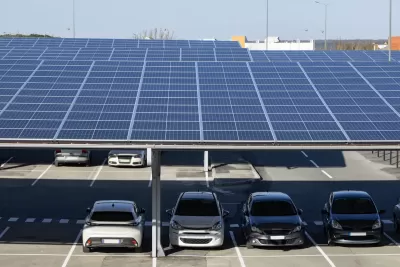
In an article for Clean Technica, Steve Hanley describes the promise of rooftop solar panels on large commercial properties and parking lots using three examples. “The beauty part is that using those roofs to generate solar power turns the owners of those properties into prosumers — people who both produce and consume their own locally generated electricity,” Hanley explains. Commercial energy users can more accurately predict what electricity will cost them over the long term.
In Maryland, a $4.8 million state program offers funding for solar power installations on parking garages and lots, which double as weather shelters. The program encourages applications with dual uses, such as projects that support community microgrids and local businesses. In Wisconsin, a Ford dealer in Fond du Lac installed solar arrays on two facilities that can produce half of the buildings’ energy needs.
On the product side, a UK company has developed an ultra-lightweight solar power system that can be installed on rooftops not suited for heavier, traditional panels. According to Hanley, just 5 percent of warehouse roof space in the UK is covered with solar panels. “A recent analysis estimates the total area of unused rooftops in the UK is 165 million square meters (1.8 billion sq. ft), with a potential solar capacity of nearly 25 GW — roughly equivalent to 25 average size nuclear power plants.”
FULL STORY: Rooftop Solar On Commercial Properties & Parking Lots Is The Next New Thing

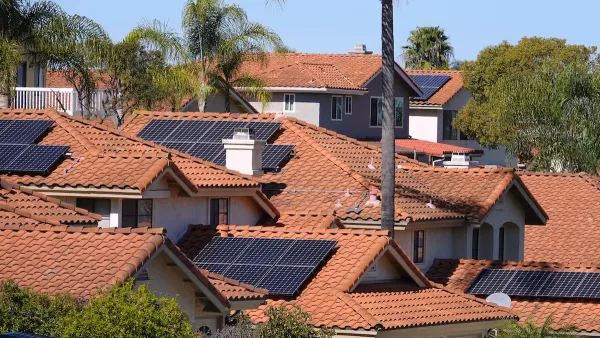
California Leads in Solar Rooftops
A combination of state and local incentives and building code mandates has helped California far outpace other states in residential rooftop solar permits.
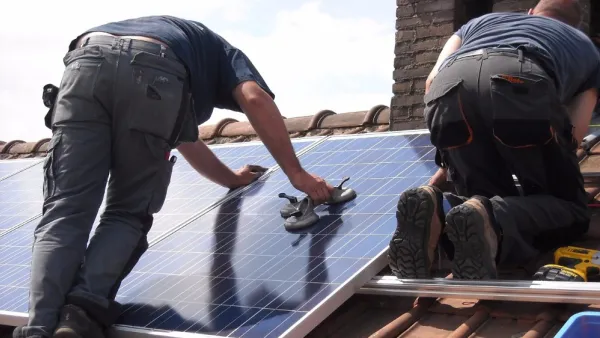
California Could Drastically Cut Solar Incentives
Rooftop solar customers in California could face higher costs and reduced incentives if a proposed overhaul of the state's solar program is approved by the Public Utilities Commission.
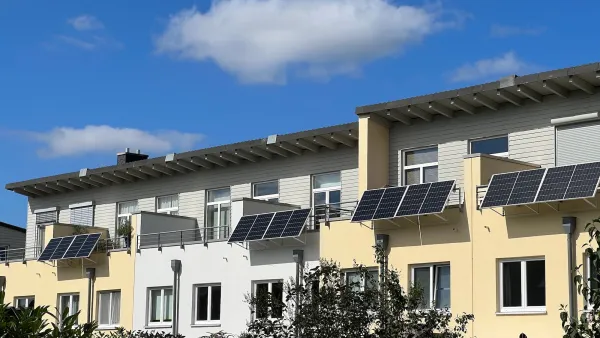
28 States and DC Could Legalize ‘Balcony Solar’
Plug-in solar panels, which are becoming popular across Europe, live in a regulatory gray area in the United States.

Planetizen Federal Action Tracker
A weekly monitor of how Trump’s orders and actions are impacting planners and planning in America.

The state-sanctioned urbicide of Austin
People don’t kill cities. Freeways do.

US to reduce Colorado River water deliveries to Mexico
A new Colorado Treaty amendment reduces Mexico’s Colorado River water allocation by 250,000 acre feet.

5 New England states march closer to 800 megawatt wind energy project
Securing federal approval for the project may be complicated under the Trump administration, which has historically been hostile towards domestic wind power.

Baltimore to break ground on $50 million Transit Priority Project
The project will bring faster bus trips, safer streets and better bike connections to Baltimore.

Airbnb launches $250 million 'last-dollar financing' housing accelerator, makes first investment in Austin
The company will put $6.4 million towards affordable housing development in Texas’ capital.

FREE Course: Walkable City 1: Why Walkability?
After describing his path towards focusing on walkability as the essence of good planning, Jeff Speck marches through his five principal reasons for making more walkable places.
Reinventing Malls: Planning Alchemy—Turning Gray Fields Into Gold
The course focuses on the opportunities and imperatives that shape reinvention of mall sites.

Eagle County Government
Harvard University Graduate School of Design
Nashville Planning Department
The Architects Foundation
University of Cincinnati Online
The Pocatello Development Authority
The Urban Renewal Agency of the City of Pocatello
Journal of the American Planning Association