The Massachusetts Bay Transportation Authority will electrify the 9 mile Fairmount Line, the shortest of their 12 commuter rail lines, using battery-electric multiple units. The first BEMU trains are projected to be operating in early 2028.


AASHTO Journal reported on Sept. 13 that the “Massachusetts Bay Transportation Authority – a division of Massachusetts Department of Transportation – recently signed off on a $54 million plan to introduce battery-electric multiple unit or BEMU trains to the Fairmount Commuter Rail Line. The first of those BEMU trains are scheduled to go into operation in early 2028.”
Keolis Commuter Services, the company that operates MBTA commuter rail lines, will begin the design and procurement process with the goal of delivering enough BEMU trains to operate 20-minute train service along the line.
Related:
- Boston Commuter Rail Recovering Rapidly, June 5, 2024
- Is it Fair to Blame Commuter Rail Woes on Private Operators? November 28, 2016
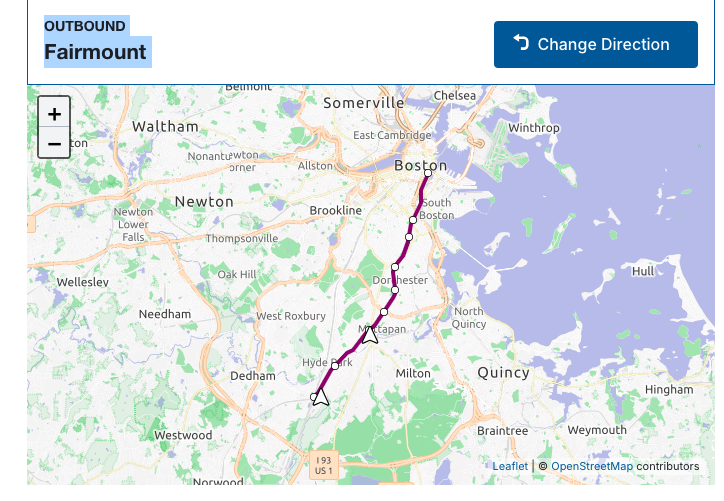
According to Wikipedia, the 9-station Fairmont line runs mainly “within Boston, running southwest from South Station through the neighborhoods of Dorchester, Mattapan and Hyde Park,” and “a short portion in Milton.”
“BEMU trains are powered by on-board batteries that are recharged by overhead catenary wires. Instead of locomotives pulling passenger cars, the batteries and motors will be integrated into four-car fixed sets,” adds AASHTO Journal.
An MBTA press release dated July 25 on the MBTA board's approval of the project indicates that catenary exists at South Station where the BEMUs would be recharged. Streetsblog Mass reported rather critically on the project in March, noting the agency's overall approach to electrification.
In fact, in spite of their electrification goals, the T has been ripping out miles of catenary wire that once powered fully-electric bus routes in Cambridge and Watertown.
It appears from the press release that Keolis will select the railcars.
With this agreement in place, Keolis will act as a Project Delivery Partner (“PDP”) to manage the new decarbonized fleet, additional power and charging infrastructure, and a new light maintenance facility.
Inquiries were made with both MBTA and Keolis – look for additional information in the comment section below this post if they respond after publication.
The MBTA commuter rail network is the nation's fifth busiest after New York's LIRR and Metro North lines, NJ Transit and Chicago's Metra.
Hat tip to AASHTO Journal weekly newsletter.
FULL STORY: MassDOT Taps Electric Trains for Commuter Rail Line

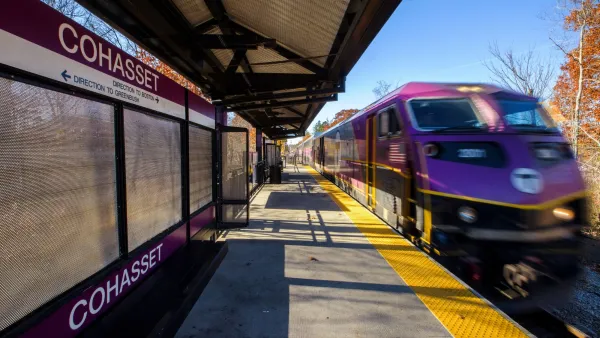
MBTA extends commuter rail discounts and lowers express bus fare to keep passengers riding into the fall
Boston-area commuters can access half-price monthly passes through November.
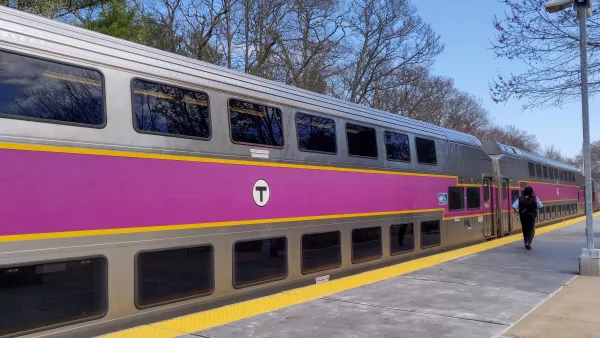
Boston Transit Ridership Grows Steadily
Ridership on the region’s commuter rail reached 80 percent of pre-pandemic levels in March.
Transit Plans Change as the Pandemic Lingers
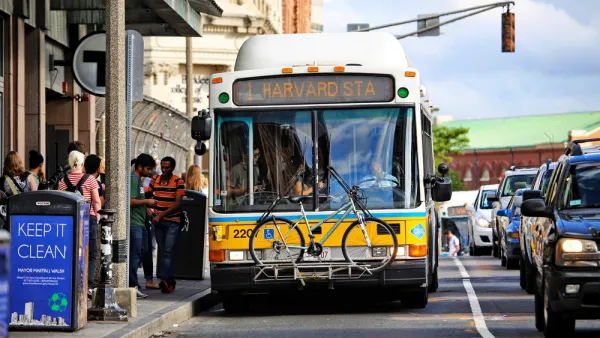
The Massachusetts Bay Transportation Authority (MBTA) this week proposed cuts to public transit service. In a decision that will likely repeat as more transit agencies undertake similar processes, the MBTA decided to prioritize buses over trains.

Planetizen Federal Action Tracker
A weekly monitor of how Trump’s orders and actions are impacting planners and planning in America.

The state-sanctioned urbicide of Austin
People don’t kill cities. Freeways do.

US to reduce Colorado River water deliveries to Mexico
A new Colorado Treaty amendment reduces Mexico’s Colorado River water allocation by 250,000 acre feet.

Baltimore to break ground on $50 million Transit Priority Project
The project will bring faster bus trips, safer streets and better bike connections to Baltimore.

Airbnb launches $250 million 'last-dollar financing' housing accelerator, makes first investment in Austin
The company will put $6.4 million towards affordable housing development in Texas’ capital.

Guerilla urbanists are building DIY bus stop benches in Chicago
A before-and-after of one of the bus stops with a new bench. The new benches are not officially sanctioned or permitted, but the residents who placed them hope they will be the start of a network of DIY benches across the city.

FREE Course: Walkable City 1: Why Walkability?
After describing his path towards focusing on walkability as the essence of good planning, Jeff Speck marches through his five principal reasons for making more walkable places.
Reinventing Malls: Planning Alchemy—Turning Gray Fields Into Gold
The course focuses on the opportunities and imperatives that shape reinvention of mall sites.

Eagle County Government
Harvard University Graduate School of Design
Nashville Planning Department
The Architects Foundation
University of Cincinnati Online
The Pocatello Development Authority
The Urban Renewal Agency of the City of Pocatello
Journal of the American Planning Association