Citing inadequate fire protection and public safety resources, the Spokane City Council has temporarily halted subdivision development in the wildland-urban interface of Latah Valley.


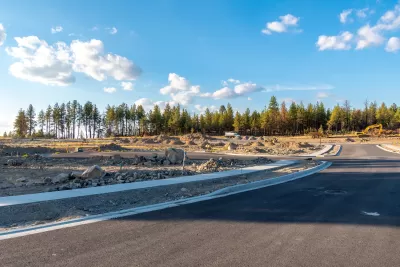
An article in NonStopLocal, the Spokane City Council passed a moratorium on the development of new subdivision housing in Latah Valley, which abuts wildland on the city’s southwestern edge. According to reporter Faith Iverson, “The Spokane City Council discussed the increased residential development specifically in the Grandview Thorpe neighborhood comparing it to the ratio of fire protection and public safety resources in the area.” The ban prohibits the city from accepting, processing, reviewing, or approving new applications for preliminary short subdivisions or preliminary subdivisions for housing in the banned zone.
This is not the first time a temporary ban has been levied on the Latah Valley neighborhood. Last year, the Inlander reported the Spokane City Council approved a six-month moratorium on development in the area in September 2022 to work on updating fees related to infrastructure costs for new developments. That ban was primarily driven by transportation infrastructure concerns. But after last summer’s wildfires burned down two homes and prompted evacuation notices in July and again in August, citizen groups began calling for a moratorium on development until the city funded the creation of a better wildfire emergency plan and a permanent fire station for the area.
Balancing risk with the need to build more housing, which often pushes development into the wildland-urban interface, will be an ongoing challenge for states and cities as the frequency and severity of wildfires grow. According to research published in the Source NM last year, close to 600,000 people in the United States were directly exposed to wildfires within 3 miles of their homes in the last two decades, 80 percent of those in western states and 70 percent in California. This growing risk has led multiple insurers to stop selling policies in high-risk states.
Read the full story: City council discussing temporary stop on housing expansion in Latah Valley

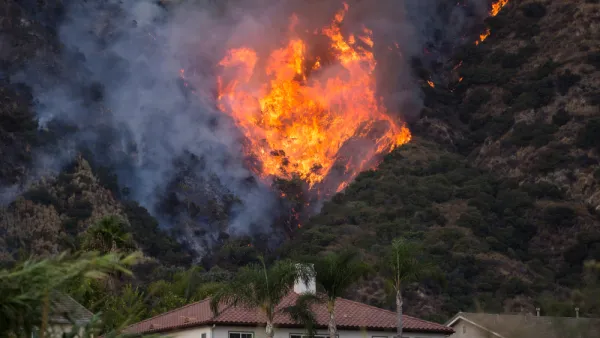
California Needs More Housing—But Where?
The state’s housing shortage is complicated by the growing number of places threatened by wildfires.
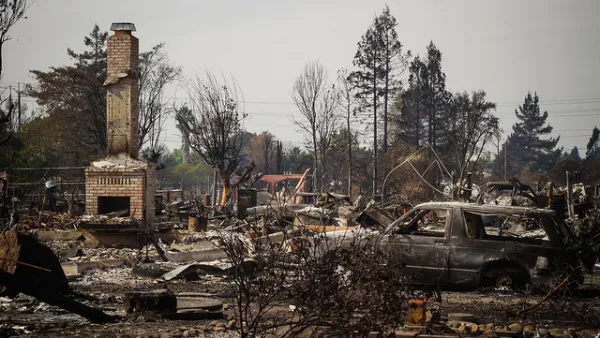
Wildfire Destroys Santa Rosa Neighborhood Outside of Fire Hazard Zone
The Wine Country wildfires destroyed Coffey Park, a subdivision within the urban boundaries of the Bay Area's fifth largest city, and outside of the state's severe fire hazard zones. But the cause wasn't a mystery to wildland fire scientists.
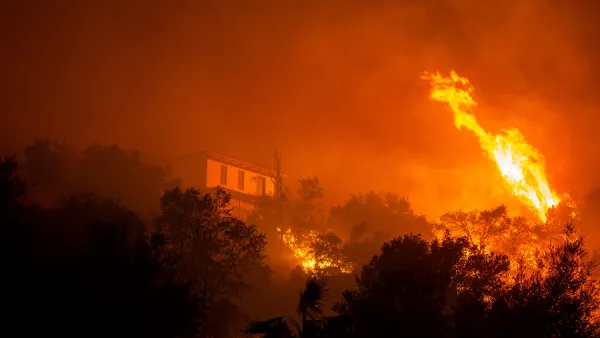
Wildfires are coming for America’s suburbs
Buying land in between paved cities and forests has become increasingly popular, but those same areas are naturally fire prone.

Planetizen Federal Action Tracker
A weekly monitor of how Trump’s orders and actions are impacting planners and planning in America.

Amtrak, CN end decades-long dispute with eight-year agreement
The new operating agreement establishes an updated framework for the companies to work together, including processes to resolve disputes.

Judges permit Denver to divert 77,000 acre feet from the Colorado River for reservoir expansion
Overuse and climate change have caused the Colorado River’s water levels to plummet.

NYC DOT wants faster, more permanent street upgrades
The city is examining ways to build more concrete infrastructure without getting entangled in 'decades-long' projects.

'Something we’ve never seen before:' rising utility rates could strain city finances nationwide
Data centers, climate change and other factors have caused utility rates in the United States to increase by 38% since 2020.

Trump to overrule local leaders, lease millions of acres of America’s Pacific Island territories’ seafloors to mining companies
International law says that the Indigenous people of America’s territories have a right to prior and informed consent regarding projects that impact their countries.

FREE Course: Walkable City 1: Why Walkability?
After describing his path towards focusing on walkability as the essence of good planning, Jeff Speck marches through his five principal reasons for making more walkable places.
Reinventing Malls: Planning Alchemy—Turning Gray Fields Into Gold
The course focuses on the opportunities and imperatives that shape reinvention of mall sites.

Harvard University Graduate School of Design
KFH Group Inc.
Greater Baltimore Committee
The Architects Foundation
University of Cincinnati Online
The Pocatello Development Authority
The Urban Renewal Agency of the City of Pocatello