The Brookings Institution releases a report that examines the location and neighborhood trends of low income housing tax credit developments.


A new survey by Lance Freeman indicates that housing developments funded by the federal Low-Income Housing Tax Credit (LIHTC) in the 1990s remain clustered in urban neighborhoods, and those containing disproportionate shares of black residents. According to the report, 58 percent of LIHTC units lie in central cities, while blacks represent one in four residents of the units surrounding neighborhoods (compared to about one in seven across all metropolitan neighborhoods). Still, the credit appears to have helped produce new federally assisted housing units in suburban areas. Nevertheless, substantial room exists for the program to expand housing choice for lower-income families beyond disadvantaged central-city neighborhoods.
Thanks to Elena Sheridan
Read the full story: Tax Credit-Supported Affordable Housing Remains Concentrated in Cities


Planetizen Federal Action Tracker
A weekly monitor of how Trump’s orders and actions are impacting planners and planning in America.

‘Going backwards:’ Baltimore mayor, students rally against state's transit funding plan
Maryland's proposed six-year plan provides no funding for Baltimore’s BMORE bus program and reduces its road maintenance funding.
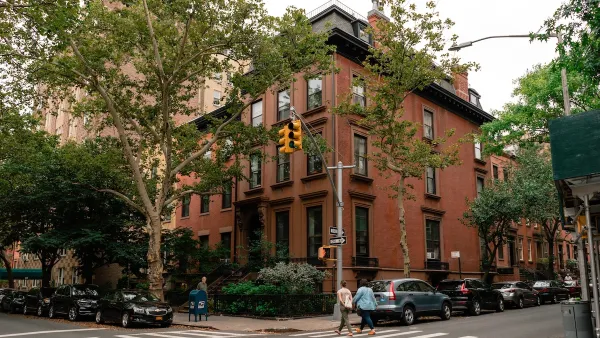
Mamdani sent nearly 6,000 pied-à-terre tax warnings to homes that didn’t qualify
A judge has ordered the administration to cancel thousands of pied-à-terre tax notices after it sent 35% of them erroneously.

Mamdani sent nearly 6,000 pied-à-terre tax warnings to homes that didn’t qualify
A judge has ordered the administration to cancel thousands of pied-à-terre tax notices after it sent 35% of them erroneously.

Detroit to transform waterfront with $2.2 billion investment
Developers will convert about 18 acres of unused parking lot space into civic spaces.

‘Going backwards:’ Baltimore mayor, students rally against state's transit funding plan
Maryland's proposed six-year plan provides no funding for Baltimore’s BMORE bus program and reduces its road maintenance funding.

FREE Course: Walkable City 1: Why Walkability?
After describing his path towards focusing on walkability as the essence of good planning, Jeff Speck marches through his five principal reasons for making more walkable places.
Reinventing Malls: Planning Alchemy—Turning Gray Fields Into Gold
The course focuses on the opportunities and imperatives that shape reinvention of mall sites.

City of Thousand Oaks
City of Wisconsin Rapids
Harvard University Graduate School of Design
The Architects Foundation
University of Cincinnati Online
Northern Illinois Transit Authority (NITA)
The Pocatello Development Authority
The Urban Renewal Agency of the City of Pocatello