Four designs cater to various street conditions and locations.


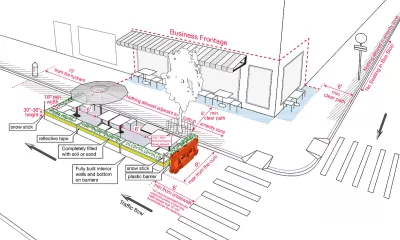
In a piece for The Architect’s Newspaper, Moses Jeanfrancois outlines New York City’s new outdoor dining regulations, highlighting the pre-approved setups designed by firms WXY and SITU.
According to the article, “The four designs address different scenarios identified as commonplace in the setups for roadway cafes.” They range from a midblock design to a corner setup for high-traffic areas and a “floating park lane” that adjusts for bike lanes.
Each setup is designed to weigh at least 150 pounds per linear foot to protect users in case of car crashes. “Modeled after Yodock water-filled traffic barriers, most of the setups have bladders that allow for weight distribution allowing the shacks to be car-proof as well.”
It remains to be seen whether most restaurants will be able to afford the investment in the new structures, which, under new program guidelines, can only be installed between April and November.
FULL STORY: Inside the new guideline-approved prototypes for outdoor dining made by WXY and SITU

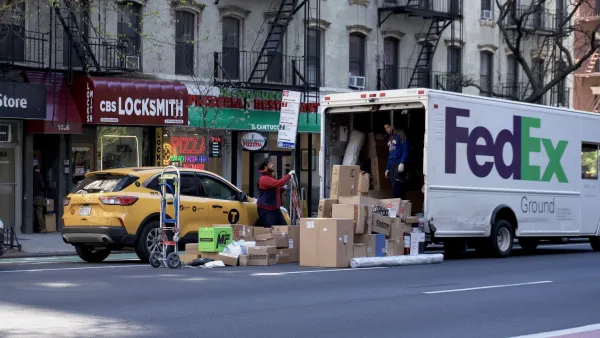
NYC launches curb management office to rein in delivery, parking chaos
New York has roughly 3 million curbside parking spots.
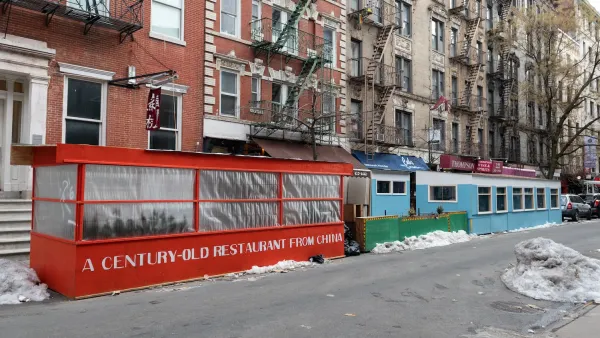
NYC Outdoor Dining Could Get a Re-Do
The city council is considering making the al fresco dining program year-round to address cost concerns from small businesses.

NYC Outdoor Dining Won’t Include Booze — For Now
Hundreds of restaurants will be unable to serve alcohol in their outdoor dining areas this summer due to a delay in permitting.

Planetizen Federal Action Tracker
A weekly monitor of how Trump’s orders and actions are impacting planners and planning in America.

The state-sanctioned urbicide of Austin
People don’t kill cities. Freeways do.

US to reduce Colorado River water deliveries to Mexico
A new Colorado Treaty amendment reduces Mexico’s Colorado River water allocation by 250,000 acre feet.

5 New England states march closer to 800 megawatt wind energy project
Securing federal approval for the project may be complicated under the Trump administration, which has historically been hostile towards domestic wind power.

Baltimore to break ground on $50 million Transit Priority Project
The project will bring faster bus trips, safer streets and better bike connections to Baltimore.

Airbnb launches $250 million 'last-dollar financing' housing accelerator, makes first investment in Austin
The company will put $6.4 million towards affordable housing development in Texas’ capital.

FREE Course: Walkable City 1: Why Walkability?
After describing his path towards focusing on walkability as the essence of good planning, Jeff Speck marches through his five principal reasons for making more walkable places.
Reinventing Malls: Planning Alchemy—Turning Gray Fields Into Gold
The course focuses on the opportunities and imperatives that shape reinvention of mall sites.

Eagle County Government
Harvard University Graduate School of Design
Nashville Planning Department
The Architects Foundation
University of Cincinnati Online
The Pocatello Development Authority
The Urban Renewal Agency of the City of Pocatello
Journal of the American Planning Association