Redeveloping just the best-suited 10 percent of America’s strip malls could result in 700,000 new affordable homes nationwide.


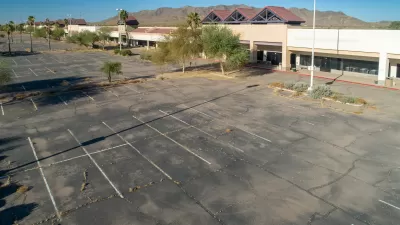
In an opinion piece for Next City, Ahmad Abu-Khalaf calls for the redevelopment of U.S. strip malls as part of the solution to the nation’s affordable housing crisis. While recent focus has largely been on office-to-housing conversions, a new analysis from Enterprise Community Partners, where he works as a senior research analyst, shows strip malls represent a bigger and lower-cost opportunity.
Enterprise research shows redeveloping just the best-suited 10 percent of America’s strip malls could result in 700,000 new affordable homes nationwide.
Strip malls offer several advantages over offices when it comes to adaptive reuse, according to Abu-Khalaf. For one, they’re everywhere; the U.S. has 947.5 million square feet of strip mall space in urban and suburban areas across the nation. Taking that into account, along with high vacancy rates, it’s likely most jurisdictions have one or more strip malls that are suitable for conversion.
And, “[u]nlike office-to-residential conversions, the redevelopment of strip malls focuses on repurposing the unbuilt portion of a site or building up from existing structures, rather than examining physically and financially feasible ways to repurpose high-rise office buildings into housing. In addition to creating new housing, mixed-use redevelopments of strip malls with retail space on the ground floor can keep existing retail tenants open and increase foot traffic,” says Abu-Khalaf. These factors can make the projects more viable.
He acknowledges strip mall conversions are not without challenges, such as site selection, zoning, a financing, and this new approach shouldn’t replace any existing strategies. He encourages local leaders to invest in removing barriers to speed up the process and points to California, which recently passed a series of laws that would allow underutilized commercial buildings to be converted into housing.
“But these increasingly vacant sites present an extraordinary opportunity. What’s happening in California can be a model for the rest of the country. With intentional efforts to remove barriers to strip mall conversions, we can significantly change the trajectory of the housing crisis in America,” say Abu-Khalaf.
FULL STORY: California Is Showing The Potential Of Strip Mall-To-Housing Conversions

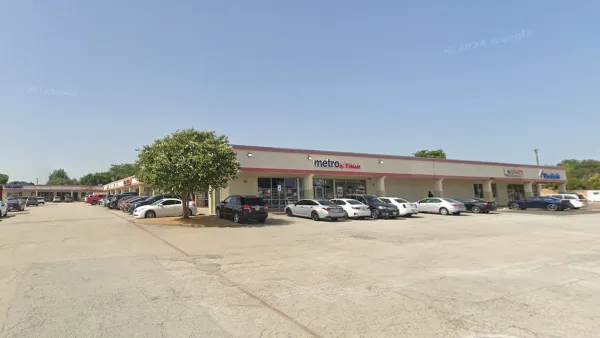
Adaptive Reuse Will Create Housing in a Suburban Texas Strip Mall
A developer is reimagining a strip mall property as a mixed-use complex with housing and retail.
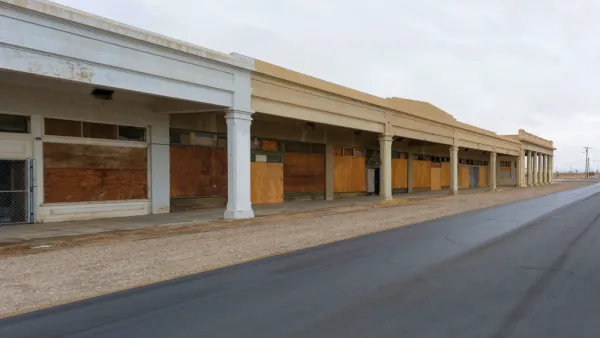
Strip Malls as a Housing Solution
The American strip mall may be a dying breed of commercial development, but could the buildings serve a new use as sustainable housing?
Madison approves hundreds of affordable apartments as deadline for federal funding looms
A recently approved project will bring 163 affordable units to the north side.

Planetizen Federal Action Tracker
A weekly monitor of how Trump’s orders and actions are impacting planners and planning in America.

The state-sanctioned urbicide of Austin
People don’t kill cities. Freeways do.

US to reduce Colorado River water deliveries to Mexico
A new Colorado Treaty amendment reduces Mexico’s Colorado River water allocation by 250,000 acre feet.

5 New England states march closer to 800 megawatt wind energy project
Securing federal approval for the project may be complicated under the Trump administration, which has historically been hostile towards domestic wind power.

Baltimore to break ground on $50 million Transit Priority Project
The project will bring faster bus trips, safer streets and better bike connections to Baltimore.

Airbnb launches $250 million 'last-dollar financing' housing accelerator, makes first investment in Austin
The company will put $6.4 million towards affordable housing development in Texas’ capital.

FREE Course: Walkable City 1: Why Walkability?
After describing his path towards focusing on walkability as the essence of good planning, Jeff Speck marches through his five principal reasons for making more walkable places.
Reinventing Malls: Planning Alchemy—Turning Gray Fields Into Gold
The course focuses on the opportunities and imperatives that shape reinvention of mall sites.

Eagle County Government
Harvard University Graduate School of Design
Nashville Planning Department
The Architects Foundation
University of Cincinnati Online
The Pocatello Development Authority
The Urban Renewal Agency of the City of Pocatello
Journal of the American Planning Association