A Maryland study recommends switching to electric tools to reduce greenhouse gas emissions and meet the state’s climate goals.



A report from the Maryland PIRG Foundation reveals that gas-powered lawn tools such as leaf blowers emit roughly the same level of “fine particulate” air pollution as 6.4 million gas-powered cars in the state.
As Josh Kurtz explains in Maryland Matters, the report, titled “Lawn Care Goes Electric: Why It’s Time to Switch to a New Generation of Clean, Quiet Electric Lawn Equipment,” estimates emissions on a county-by-county basis and calculates the benefit of removing gas-powered equipment.
“The report recommends that local and state governments use electric equipment on public property and provide financial incentives to encourage the widespread adoption of electric lawn equipment by residents. It further suggests that cities and states consider restrictions on the sale and use of the most-polluting fossil fuel-powered equipment.” One Maryland county, Montgomery County, is already moving to phase out gas-powered leaf blowers and vacuums and will prohibit their sales in the county starting on July 1, 2024, with a full ban taking effect a year later.
Read the full story: Study: Gas-powered lawn mowers and leaf blowers produce as much pollution as long car trips
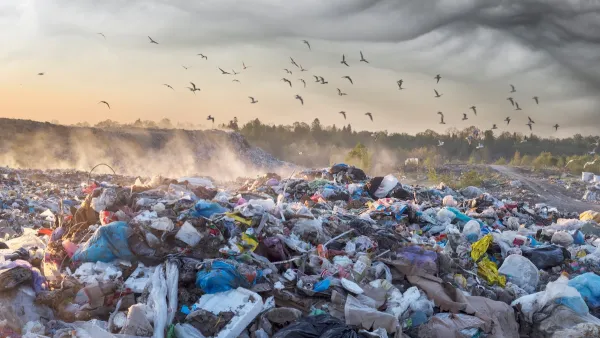
Colorado Landfills Emit as Much Pollution as 1M Cars
Landfills are the third-largest source of methane pollution in Colorado, after agriculture and fossil fuel extraction.

Driving Equity and Clean Air: California Invests in Greener School Transportation
California has awarded $500 million to fund 1,000 zero-emission school buses and chargers for educational agencies as part of its effort to reduce pollution, improve student health, and accelerate the transition to clean transportation.

New Jersey to Consider Charging Fossil Fuel Companies for Pollution
A proposed law would make companies liable for damages caused by burning fossil fuels.

Planetizen Federal Action Tracker
A weekly monitor of how Trump’s orders and actions are impacting planners and planning in America.

California plans to bury El Niño’s downpour
If the state plays its cards right, it may be able to store a billion acre-feet of El Niño’s water in aquifers.

Desperate measures: Advocates weigh draining Lake Powell to fill Colorado River
Draining the reservoir could reduce evaporation losses by a couple hundred thousand acre-feet.

Housing is the top priority of Seattle’s sole new councilmember
Jenks campaigned on building 1,000 new units of affordable housing.

New tax cuts may slash $1.5 billion in funding for Miami transit, public parks
Amendment 3 will save Miami-Dade homeowners $2,700 in 2028.

Arizona, Wisconsin, Pennsylvania hope to finally advance climate goals post-midterms
The three states have spent years under Republican or divided control.

FREE Course: Walkable City 1: Why Walkability?
After describing his path towards focusing on walkability as the essence of good planning, Jeff Speck marches through his five principal reasons for making more walkable places.
Reinventing Malls: Planning Alchemy—Turning Gray Fields Into Gold
The course focuses on the opportunities and imperatives that shape reinvention of mall sites.

City of Rosemead
Rutgers University, Edward J. Bloustein School of Planning and Public Policy
One Hundred Miles
University of Michigan School for Environment and Sustainability (SEAS)
Hunter College, City University of New York (CUNY)
The Architects Foundation
City of Cambridge
Montrose County
The Pocatello Development Authority