Gov. Kathy Hochul approved more than 20 renewable energy projects that will deliver 12 percent of the state’s energy needs by 2030.



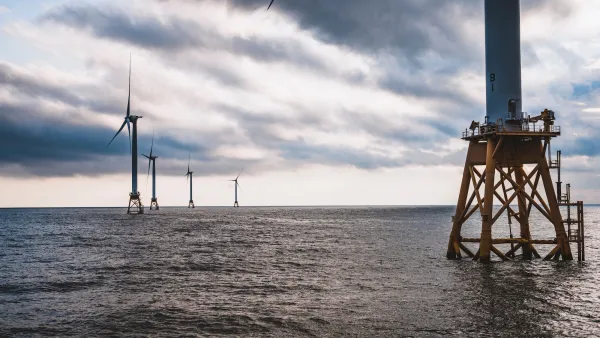
“Gov. Kathy Hochul has approved three offshore wind and nearly two dozen renewable energy projects to help New York shift to meet the state’s climate goals to reduce greenhouse gas emissions,” reports J.D. Allen for WSHU.
When complete, “The offshore and land-based projects will deliver 12% of New York’s electricity needs by 2030 — when the state aims to have shifted to generating 70% of its energy from renewable sources.” The governor also approved a $300 million investment to support the production of wind turbine components in upstate New York.
Offshore wind production has faced some backlash from local residents concerned about views, impact on the fishing industry, and the land-based transmission infrastructure required. Vineyard Offshore, a company building the first U.S. offshore wind farm in Martha’s Vineyard and operator of one of the three New York projects, “plans to bring a ‘community first approach’ to land high-powered transmission cables in Long Beach, as it did in Barnstable, Massachusetts.”
Read the full story: New York approves trio of offshore wind, dozens more renewable energy projects on land

California presses forward on offshore wind
The state is taking steps to prepare its grid and port infrastructure for offshore wind projects despite the federal government's pushback on the technology.
Trump Administration to Pay Energy Firm $1 Billion to Kill Wind Farms in Favor of Fossil Fuel Projects
TotalEnergies will forfeit its lease on two proposed wind energy projects off the coasts of New York and North Carolina.
Nation’s Largest Offshore Wind Project, Suspended by Trump, Restarts Construction
A judge issued a temporary restraining order against the Trump administration’s suspension of five East Coast offshore wind projects.

Planetizen Federal Action Tracker
A weekly monitor of how Trump’s orders and actions are impacting planners and planning in America.

California plans to bury El Niño’s downpour
If the state plays its cards right, it may be able to store a billion acre-feet of El Niño’s water in aquifers.

Desperate measures: Advocates weigh draining Lake Powell to fill Colorado River
Draining the reservoir could reduce evaporation losses by a couple hundred thousand acre-feet.

US buildings threatened, destroyed by fires set to triple by 2060
Researchers found a high fire risk for socioeconomically vulnerable neighborhoods in the American West.

LA residents may be allowed to paint their own crosswalks
Councilwoman Katy Yaroslavsky put out a motion instructing the Los Angeles Department of Public Transportation to study the feasibility of allowing volunteers to paint crosswalks.

Dallas moves to overhaul its zoning code
The city's zoning reform will allow more multi-family and mixed-use developments.

FREE Course: Walkable City 1: Why Walkability?
After describing his path towards focusing on walkability as the essence of good planning, Jeff Speck marches through his five principal reasons for making more walkable places.
Reinventing Malls: Planning Alchemy—Turning Gray Fields Into Gold
The course focuses on the opportunities and imperatives that shape reinvention of mall sites.

City of Rosemead
Rutgers University, Edward J. Bloustein School of Planning and Public Policy
One Hundred Miles
Hunter College, City University of New York (CUNY)
The Architects Foundation
University of Cincinnati Online
City of Cambridge
Montrose County
The Pocatello Development Authority