Cities are trying to stretch affordable housing funds to meet the demand for both short- and long-term housing.



An article by Jeanne Kuang in CALmatters argues that, despite concerns about their effectiveness, ‘tiny homes’ are likely to remain an important part of California’s efforts to eliminate homelessness.
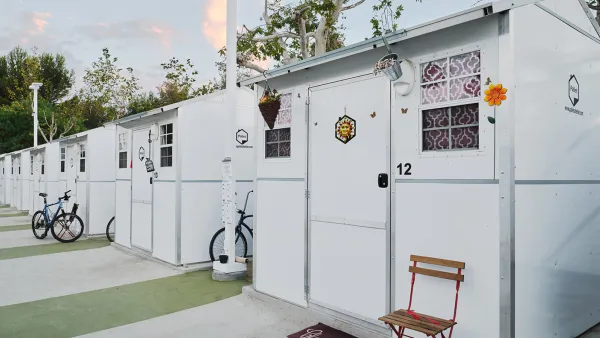
‘Tiny home villages,’ as the projects are known, “aim to fill the steps between traditional, congregate homeless shelters — think ‘room full of bunk beds and cubicles’ — and an apartment of one’s own.”
Also known as modular homes or ‘emergency interim housing,’ these prefabricated structures can offer a stepping stone to long-term housing. San Jose city officials say the city’s unsheltered population has declined by 10 percent after the city opened six tiny home sites, and “of the 1,500 people the city has sheltered in its tiny home sites, 48% moved to permanent housing.”
While tiny home villages may offer a lifesaving stopgap, advocates warn that ending homelessness will require a larger effort to address the root causes of high housing costs and the lack of affordable housing. The article notes other conflicts arising as tiny homes become a more permanent fixture, such as their legal status and whether tenants should be charged rent.
FULL STORY: Why tiny homes will remain part of California’s homelessness equation for years

The Role of Microhousing in Ending Chronic Homelessness
Affordable, quick-build ‘tiny homes’ can serve as a key stepping stone to a permanent housing situation for people experiencing homelessness.

Michigan Capital's $640K ‘Pod’ Homes for Homeless Residents not Approved for Winter Use
Lansing officials approved a plan to purchase 50 modular micro-housing units as emergency shelter for the city’s unhoused residents.

Tiny House Villages for Addressing Homelessness: An Interview with Yetimoni Kpeebi
One researcher's perspective on the potential of tiny homes and owner-built housing as one tool to fight the housing crisis.

Planetizen Federal Action Tracker
A weekly monitor of how Trump’s orders and actions are impacting planners and planning in America.

The state-sanctioned urbicide of Austin
People don’t kill cities. Freeways do.

US to reduce Colorado River water deliveries to Mexico
A new Colorado Treaty amendment reduces Mexico’s Colorado River water allocation by 250,000 acre feet.

Mamdani overhauls NYC's Vision Zero plan with 100 new policy goals
The overhaul aims to reduce traffic deaths and make streets safer for pedestrians, cyclists and drivers through lower speed limits, new safety infrastructure and more.

Amtrak not solely to blame for New Jersey commuter rail's unreliability, report finds
A new study from the Garden State Initiative found that NJ Transit’s budget grew 20% across a 4 year period, but reliability declined significantly over the same period.

EPA erases limits on planet-warming pollution from power plants
Under Monday’s plan, power plants would still have some limits on how much mercury, arsenic and other contaminants they can emit.

FREE Course: Walkable City 1: Why Walkability?
After describing his path towards focusing on walkability as the essence of good planning, Jeff Speck marches through his five principal reasons for making more walkable places.
Reinventing Malls: Planning Alchemy—Turning Gray Fields Into Gold
The course focuses on the opportunities and imperatives that shape reinvention of mall sites.

Eagle County Government
Harvard University Graduate School of Design
Nashville Planning Department
The Architects Foundation
University of Cincinnati Online
The Pocatello Development Authority
The Urban Renewal Agency of the City of Pocatello
Journal of the American Planning Association